


Hemani Kandhari
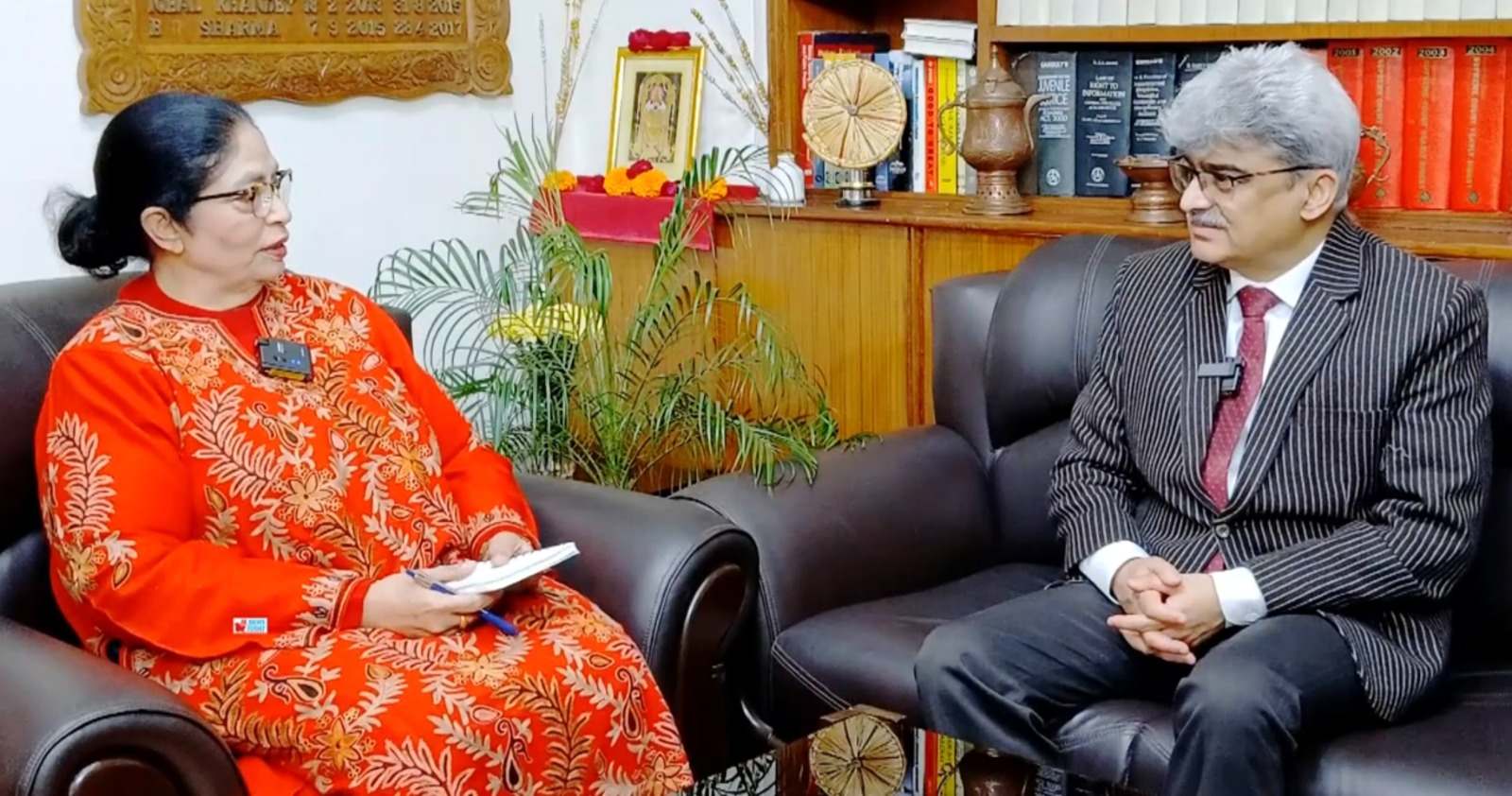
December 4, 2025 : In an exclusive interview with JK News Today Editor Binoo Joshi, Jammu and Kashmir Chief Secretary Atal Dulloo said that the administrative capacity in the Union Territory has significantly strengthened over the past few years. He said departments have undergone major capacity-building initiatives and officers are now better equipped to implement complex schemes and face emergencies. Citing the events of 2025 including the Pahalgam attack, Operation Sindoor, targeted killings from across the border, and unprecedented rains that caused serious infrastructure damage, Dulloo noted that “the administration responded together with a whole-of-government approach and development work & did not stop despite challenges.”

Speaking about the floods that hit Jammu Province, Samba, Kathua and the mountainous regions, he said the damage to infrastructure and the loss of life was extensive. He personally visited the affected areas and observed officials from central and UT departments working round-the-clock. Temporary road restorations were completed within days, while permanent works have begun, though they will take time due to the scale of destruction. Referring to major structures such as the 4th Tawi Bridge, Ravi Bridge and the bridge near AIIMS, he said significant restoration is underway.
Calling the train connectivity to Kashmir a historic and particularly complicated engineering project due to the mountainous and tectonically dynamic terrain, the Chief Secretary said the Vande Bharat service between Jammu and Katra has already reduced travel time and benefitted trade, tourism, and movement of perishable goods. Once the Jammu route becomes operational, rail travel will become the preferred choice and provide an alternative in case of highway disruptions.
On the financial health of the UT, Dulloo acknowledged pressure caused by rising expenditure and slower revenue growth which earlier led to accumulative debt. He said the administration is now following strict financial discipline and reform measures to reduce loan dependence, stop off-budget borrowings, and ensure transparency through e-tendering and digital governance. Direct Benefit Transfer, he added, has been a game changer by reducing leakages and improving savings.
Discussing education reforms, Dulloo said the Vidya Samiksha Kendra established by the Government of India allows complete monitoring of government and private schools. Features such as teacher and student attendance through facial recognition, student performance tracking, and adaptive learning models are being used to improve outcomes. Smart classrooms under Samagra Shiksha will particularly benefit students in border and hilly areas.
On the health sector, he said Jammu and Kashmir is fortunate to have a strong public health structure, strengthened further by the Ayushman Bharat scheme that allows patients to access treatment in both public and private hospitals. The UT is focusing on expanding critical care services, trauma care, cancer and cardiac treatment, and mental health support across seven newly operational government medical colleges. An expert committee supported by NITI Aayog is drafting a plan to upgrade services and infrastructure. A committee, supported by NITI Aayog and headed by the Health Secretary and AIIMS Jammu Director, will prepare an action plan to upgrade services.
Commenting on the power sector, the Chief Secretary shared that dependence on hydropower results in lower winter production, forcing high-cost purchasing. Under the RDSS scheme, efforts are underway to strengthen distribution systems, reduce losses and monitor consumption and revenue digitally. Solar energy adoption is expanding, with 10,000 beneficiaries and 1,400 households now paying zero electricity bills. Government buildings are also being connected to solar power.
He said the Har Ghar Jal scheme is 80 percent complete and pending gaps are being resolved with additional funding expected.
For major connectivity projects in J&K, he emphasised that Four of the five patches of the Jammu–Srinagar four-laning project are complete, while a tunnel and viaduct remain under execution. The Delhi–Katra Expressway is progressing rapidly and is expected to be operational by 2026 despite some flood-related delays and operational disruptions.
Speaking on the fight against drugs, Dulloo said strict enforcement under the NDPS Act has made bail difficult, and five special courts have been set up for faster action. Awareness campaigns involving doctors, police and social welfare officials are being conducted in every ward and panchayat to inform young people and families about risks and prevention. Concluding, the Chief Secretary said Jammu and Kashmir is moving forward with stronger systems, improved accountability, and governance focused on service delivery and reform.
