


Hemani Kandhari
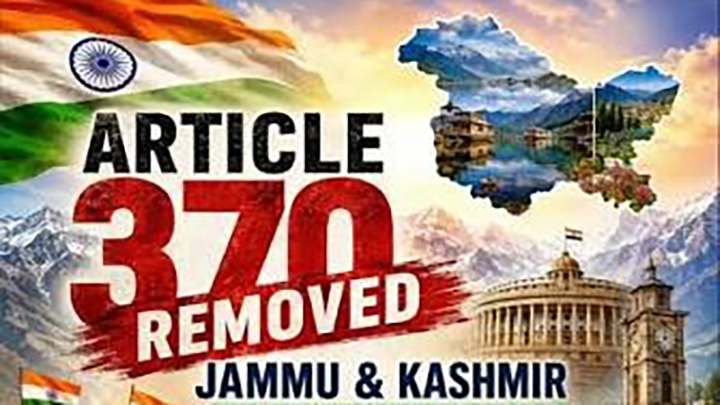
August 6, 2026: August 5, 2026 marked seven years since the abrogation of Articles 370 and 35A and the implementation of the Jammu and Kashmir Reorganisation Act, 2019. The former state of Jammu and Kashmir was reorganised into two Union Territories—Jammu and Kashmir, and Ladakh. Seven years later, the political debate in the region continues, but one important question remains: Is the absence of a common political agenda delaying progress on key issues such as the restoration of statehood?
The Union Government has repeatedly stated in Parliament that the statehood of Jammu and Kashmir would be restored at an “appropriate time.” During the hearings on Article 370, the Centre also assured the Supreme Court that statehood would be restored. In its December 2023 judgment, while upholding the constitutional validity of the 2019 changes, the Supreme Court recorded this assurance and observed that the restoration of statehood should take place “at the earliest and as soon as possible.”

However, despite the passage of time and the successful conduct of Assembly elections in 2024, the restoration of statehood remains pending. This has become a matter of public discussion across Jammu and Kashmir.
One challenge is the lack of political consensus. Different political parties and organisations continue to raise different demands. Some seek only the restoration of statehood. Others demand the restoration of Articles 370 and 35A, while some advocate for a special constitutional status or protections similar to those available under Article 371 for certain states. There are also voices calling for separate statehood for Jammu.
While every political party has the democratic right to present its own vision, the absence of a unified demand may weaken the overall message reaching New Delhi. When every group speaks with a different voice, it becomes difficult to identify the region’s single most urgent political priority.
A comparison is often made with Ladakh, where various stakeholders came together to prepare and submit a common set of demands to the Ministry of Home Affairs. Whether one agrees with those demands or not, they reflected a coordinated approach. In contrast, political discourse in Jammu and Kashmir has often appeared fragmented.
The past seven years have also witnessed important changes on the ground. Security indicators have improved in several respects compared to earlier years, including a big fullstop on stone-pelting incidents and no recruitment into terrorist organisations, although terrorism has not been eliminated. The region has continued to witness deadly attacks, including incidents in Rajouri ,Reasi, Kathua, Baisaran, Kulgam and other areas, reminding everyone that security challenges remain serious.
At the same time, Jammu and Kashmir has seen significant infrastructure development, expanding tourism, improved connectivity—including the completion of major railway links , National Highways, Ring-Roads, Tunnels; some undergoing projects like Jammu-Srinagar Airport Expansion—and the implementation of various development projects. More students, tourists, professionals and businesses from across India are visiting the region than before. These developments have contributed to economic activity and increased public interaction with the rest of the country.
The peaceful conduct of the 2024 Assembly elections was another important milestone. Voters elected a National Conference-led coalition government, reflecting the return of an elected political administration. Many people expected that this democratic transition would strengthen the case for restoring full statehood.
The debate today is no longer only about the events before or after 2019. It is increasingly about the future. Regardless of political ideology, many citizens believe that development, peace and democratic governance should move together. If statehood is considered the immediate priority, a broader political consensus may help communicate that demand more effectively.
Differences of opinion are natural in a democracy, and every political party has the right to pursue its own agenda. Yet history also shows that when regions speak with clarity and unity on a common constitutional issue, their message often carries greater political weight.
Seven years after the reorganisation of Jammu and Kashmir, the question is not merely whether statehood should be restored—that demand has already been voiced by many political parties and acknowledged in commitments made by the Union Government and before the Supreme Court. The larger question is whether the political leadership of Jammu and Kashmir can rise above party lines and present a united roadmap for the future.
A shared vision may not solve every problem overnight, but it could provide the clarity that many citizens feel is currently missing.
