
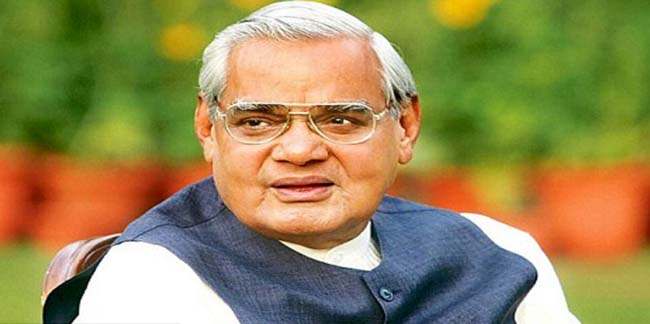
His legacy of humanity, cultural respect and democratic faith still resonates across Jammu and Kashmir
By Altaf Thakur
BJP JK spokesman
Srinagar | Dec 25: As the nation commemorates the birth anniversary of former Prime Minister Atal Bihari Vajpayee, Jammu and Kashmir remembers him not merely as a national leader, but as a statesman who reached out to the region with empathy, dignity and moral courage. In a political landscape often marked by distance and distrust, Vajpayee stood apart for his effort to engage Kashmir through understanding rather than assertion.
A poet by temperament and a democrat by conviction, Vajpayee believed that governance must be rooted in compassion. His association with Jammu and Kashmir began early in his political life. During the 1950s, as a young leader, his visits to the Valley acquainted him with its layered history, cultural richness and the sensitivities of its people. Those formative experiences shaped his belief that Kashmir could only be addressed through sensitivity, respect and sustained engagement.
That belief found its most powerful expression during his tenure as Prime Minister. In April 2003, Vajpayee visited Srinagar at a time when uncertainty weighed heavily on the region. His presence itself carried a message — that New Delhi was willing to listen. Addressing large gatherings, he spoke not as a distant authority but as a fellow citizen, acknowledging the emotional and social complexities of the Valley while reaffirming faith in democratic processes.
It was during this period that Vajpayee articulated his timeless vision for Jammu and Kashmir: “Insaniyat, Kashmiriyat, Jamhuriyat.” The three principles — humanity, respect for Kashmir’s unique cultural ethos, and democracy — were not mere political slogans but a moral framework. They emphasized human dignity, celebrated the region’s pluralistic traditions, and reaffirmed the centrality of people’s participation in governance.
Under Vajpayee’s leadership, democratic institutions in Jammu and Kashmir were strengthened. Assembly elections held during his tenure witnessed notable public participation despite challenges, reinforcing confidence in the electoral process. His approach sought to reduce alienation by encouraging dialogue with regional leadership and civil society, underscoring the idea that democracy is most effective when it listens.
Vajpayee’s engagement with the region also extended beyond politics to people-centric initiatives. He believed that connectivity — social, cultural and economic — was essential for building trust. His tenure encouraged greater interaction, exchange and movement, nurturing a sense of inclusion and shared national purpose.
Across Jammu and Kashmir, Vajpayee continues to be remembered with a rare sense of respect cutting across political lines. Community elders, civil society members and mainstream political leaders have often recalled his sincerity and warmth. His speeches in Srinagar, delivered in measured tones and thoughtful words, are still remembered as moments when the highest office in the country spoke directly to the conscience of the people.
His legacy is also reflected in enduring symbols of development. Atal Setu, the cable-stayed bridge over the Ravi River near Basholi in Kathua district, stands as a tribute to his vision of connectivity and progress — a reminder that bridges, both physical and emotional, are vital to national integration.
Years after his passing, Atal Bihari Vajpayee’s imprint on Jammu and Kashmir remains distinctive. He is remembered as a leader who chose empathy over expediency, dialogue over distance, and democracy over distrust. In doing so, he left behind not just policies, but a memory of statesmanship that continues to inspire hope and reflection in the region.