
JK News Today
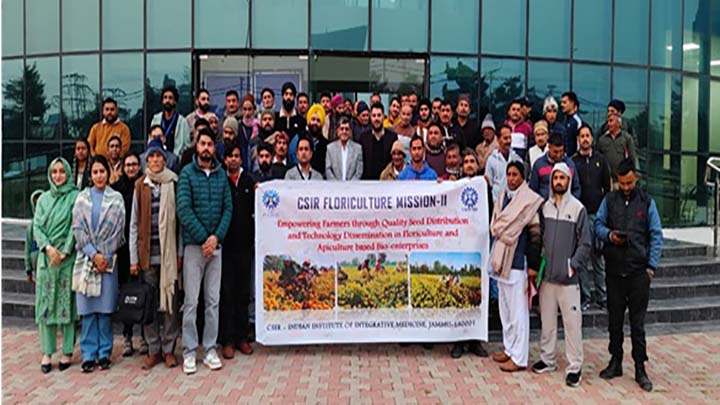
KATHUA, JANUARY 06: The CSIR-Indian Institute of Integrative Medicine Jammu organised a workshop on “Empowering Farmers through Quality Seed Distribution and Technology Dissemination in Floriculture and Apiculture-based Bioenterprises” at the Industrial Biotechnology Park (IBTP) Ghatti-Kathua.
The programme was organised under the CSIR Floriculture Mission, a flagship initiative of Dr. Jitendra Singh, Union Minister of Science and Technology, aimed at promoting high value floriculture based enterprises and enhancing farmers’ income through science led interventions.
The workshop witnessed enthusiastic participation from around 150 farmers from Samba and Kathua districts of Jammu and Kashmir.
The programme was designed to provide comprehensive exposure to scientific technologies, best practices and market oriented approaches in commercial floriculture, apiculture and allied value-added enterprises, thereby enabling farmers to diversify their income sources and adopt sustainable agri-business models.
Director CSIR-IIIM Jammu, Dr Zabeer Ahmed was the Chief Guest and delivered the presidential address. In his address, Dr Ahmed underscored the immense potential of commercial floriculture and beekeeping as profitable and highly remunerative income generating activities, particularly for small and marginal farmers in rural and peri-urban regions. He informed that CSIR Floriculture Mission is being implemented under the visionary guidance of Dr Jitendra Singh, Union Minister for Science and Technology and emphasised that floriculture and apiculture are promising farm sectors, employment intensive and capable of providing quick economic returns when supported by quality planting material, scientific crop management practices and efficient market linkages.
Dr Ahmed highlighted that availability of quality seeds and planting material, adoption of standardised production protocols and integration with value chains and markets are critical drivers for developing sustainable agri-enterprises. He further stated that CSIR-IIIM Jammu, through its research, development and extension activities is committed to bridging the gap between laboratory innovations and farmer fields, thereby contributing to rural prosperity and inclusive growth.
Nodal Scientist of the Mission, Dr Shahid Rasool provided a detailed overview of the mission’s objectives and the pivotal role being played by CSIR-IIIM Jammu in promoting science based agrarian transformation in the region. He elaborated on the Institute’s concerted efforts in disseminating improved varieties of ornamental and floricultural crops, standardising cultivation, post harvest technologies and implementing farmer centric extension and capacity building models.
Dr Rasool highlighted the commercial significance of high value cut flowers such as gladiolus, lilium, carnation and gerbera, which have strong domestic demand and emerging export potential. He also informed that bulbous ornamental crops, including tulips and lilies are increasingly being adopted by farmers due to their high market value and suitability to local agro-climatic conditions. Emphasis is being laid on scientific nursery raising, planting techniques, nutrient management, pest and disease control, harvesting practices and post harvest handling to ensure superior quality produce, he said.
Prominent floriculturist and member J&K Kisan Advisory Board, Tejinder Singh, while speaking at the event, shared his practical experiences and market insights with the participants. He informed that commercial floriculture is a viable agribusiness enterprise in J&K owing to high demand of flowers in the region. He stressed on the importance of understanding market trends, crop planning based on demand, maintaining quality standards and adopting collective marketing and farmer producer models to reduce risks and enhance bargaining power. He appreciated the significant contributions of CSIR-IIIM in imparting advanced scientific techniques in floricultural crop production and management to the farmers across J&K and informed that the quality seed and planting material provided under the Mission to more than 3500 farmer beneficiaries has brought transformative change in the floriculture sector and positively impacted the socio-economic status of the farmers benefited in J&K.
The participating farmers were imparted skill training on scientific crop production, insect disease management and post harvest handling of floricultural crops. Technical presentations and demonstrations were given on commercial cultivation of marigold, lilium, gladiolus, gerbera and other ornamental crops. Farmers were imparted scientific and practical skill for integrated apiculture in floriculture based farming systems for production of honey, beeswax and other hive products. Technical sessions covered scientific beekeeping practices, including hive management, seasonal management of colonies, disease and pest control and methods for ensuring quality honey production, as well as the importance of maintaining quality standards for market acceptance.
An important component of the workshop was value addition in floriculture produce, aimed at enhancing farmers’ profitability and minimising post-harvest losses. Opportunities in dry flowers, floral crafts, essential oils, natural dyes, garlands, bouquets and floral based decorative items were highlighted. The workshop also focused on landscape designing and ornamental horticulture as emerging livelihood opportunities. Experts sensitised farmers about the growing demand for landscaping services in urban green spaces, flori-tourism infrastructure, public parks, hotels and residential projects.
The interactive sessions enabled farmers to engage directly with scientists and experts and discuss location-specific challenges related to cultivation practices, disease management, marketing and viability. The hands-on discussions reinforced confidence among farmers and encouraged them to adopt scientific technologies demonstrated during the programme.
The workshop concluded with an emphasis for collective engagements of scientists, farmers and market stakeholders to build resilient and profitable agri-enterprises.