


JK News Today Commentary
Over the past few years, Jammu and Kashmir has been a witness to Government of India’s commitment to zero-tolerance toward terrorism and its dividends are there for all to share. Nation is seeing a change, and so is J&K which not long ago was dismissed as a gone case . Things have been reversed to the great delight of the nation, but enemies of peace are active and this what should make the national counterterrorism policy and strategy – Prahaar- to begin its work from J&K .
This policy document released on Monday- February 23 , 2026- is both an eye opener and way forward to fight terrorism within the country and abroad. Though written in a random fashion, some of its contents have universal value , which make India’s zero tolerance to terrorism as a template for all the countries combating terrorism in various forms and manifestations.

In the given circumstances , though it requires the whole of the country approach as terrorists , by their training and motivation have the tendency to surprise and shock the security agencies and the masses , it is worthwhile to apply this strategy in Jammu and Kashmir where terrorism , having both internal and external dimensions continues to pose a severe challenge . Apart from all the counter-terror methods , including actions by security agencies , it should be made a ground to test the whole of the society approach .
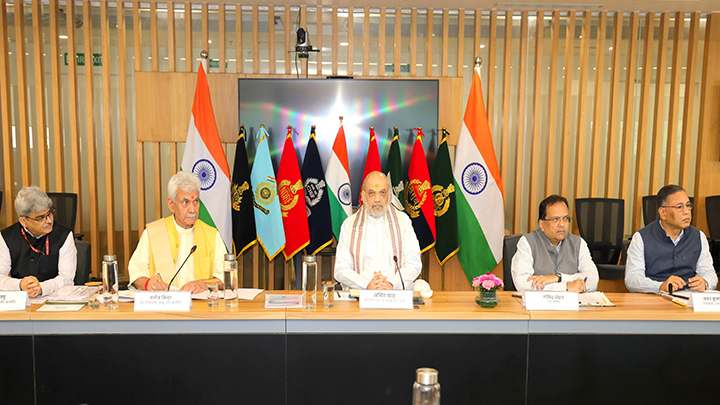
Union Home Minister Amit Shah, time and again has stressed the need for making J&K terror and fear-free and called for an all-out approach to deal a decisive blow to the terrorism . that, in itself underscores that how important it is to wipe out terrorism for once and all from this territory and lives of the people here.
Amit Shah’s vision can be taken forward by application of this national counter-terrorism policy and strategy in J&K. That will serve as a template for the rest of the country, as wiping out of terrorism from J&K will have both national and international dividends delivered to the counter-terrorism apparatus in India.
As listed in the policy and strategy paper , India has faced all sorts of threats , ranging from Jihadi outfits to the groups operating in the counties in the region , to the global networks of Al-Qaeda and ISIS , Jammu and Kashmir was used as a theatre by these groups and their offshoots to wage a war against the Indian state. That makes it important for the strategists and policy makers to assess emerging threats of broadcast of the anti-India and pan-Islamic agenda in the cyber space in the context of J&K. That will help in applying this strategy more effectively in the rest of the country.
This strategy which has framed by taking all internal and external threats into account also synergizes with the policy statement how to counter the threats . It is to neutralize threats as when they surface , but its basic essence is in preempting the threats . India, knows by its experience that how ignoring of the emerging threats made its system dysfunctional for years, especially in Jammu and Kashmir, and Punjab . North-east too figured as trouble spot for years together . Now the things have started changing because of the will and capacity of the system to deal with the threats ..
As was natural , this strategy is aimed at securing safety and security of all the Indian citizens from the terror threats hovering in the horizon . These threats have been analyzed in clear terms , based on the past experience and also on the basis of the analysis of the threats emanating in the surroundings . In realistic terms, it foresees threats from the countries known for using terrorism as their state policy.
Although no country has been mentioned by name , the references are very clear ; Pakistan has made Jammu and Kashmir as a theatre of terror of various kinds in the past over three and a half decades .It is in this state/ UT that Pakistan used various techniques to bleed India . Its real acts of violence were seen and witnessed in the beginning of 1990 , but it had been plotting for extremist violence over the past several years .The failure lay in not reading the designs of Pakistan in launching proxy war in Jammu and Kashmir before it actually started . That was an abject failure of the governments at the Centre .
The course correction started from 2014 onwards , but more firmly since 2016- when India conducted its first surgical strike against Pakistan in Pakistan occupied Kashmir, in September 2016 when it retaliated to a terror attack in Uri in which 20 Indian soldiers were killed by terrorists. But it gained greater strength after India struck deep inside Pakistan- Balakot in Khyber Pakhtunkhwa in February 2019 in retaliation to Pulwama terror attack which left 40 CRPF personnel dead. Similar retaliatory strikes were launched in the wake of ghastly Pahalgam massacre ( April 22, 2025) under Operation Sindoor that brought Pakistan to its knees.
Over the years, J&K has seen changing faces of terrorism – from exploitation of the local Kashmiri youth , drafting them as terrorists who killed fellow Kashmirs , and made the miniscule minority of Kashmiri Pandits to flee their homes- they haven’t returned to their homes yet . That in itself is prolonged impact of terrorism of early 1990s, which has not been reversed even after 36 years, during which thousands of terrorists have been killed . Their ecosystem has suffered huge damage but it continues to nurture the designs to destabilize the situation
Jammu and Kashmir has come into a specific mention because for decades it continued to be a byword for terrorism in the country, where Indians from other parts feared to travel. This terrorism created uncertainty between Indians in other parts of the country and J&K.
The counter-terrorism strategy of India , “ PRAHAAR”, flows from the ideals of saving Indian citizens by pursuing zero-tolerance against terrorism and is predicated by the guidelines : Prevention of terror attacks to protect Indian citizens and interests ; Responses which are swift and proportionate to the threat posed ; Aggregating internal capacities for achieving synergy in a whole of government approach ; Human rights and “ Rule of Law” based processes for mitigation of threats ; Attenuating the conditions enabling terrorism , including radicalization ; Aligning the shaping of international efforts to counter- terrorism : Recovery and resilience through a whole of society approach.
The way forward listed in the document is quite realistic as it recalls successes but not without pointing as to what needs to be done., like it has noted that the “ coordinated multi-agency actions have greatly contributed towards success in Indian counter-terrorism efforts . However, there remains a scope for further cooperation and collaboration among various agencies for intelligence collection and investigation.” It has also called for continuous change in legal regime to respond to emerging challenges . In addition , there is a continual need for capacity-building of the counter-terrorism units / ATS of States/ UTs to respond to, neutralize and investigate terror-related incidents .
The document underlines that India will continue to work for a comprehensive framework on international terrorism while pursuing its counter terrorism policy and strategy ‘Prahaar” , which aims to criminalize all terrorist acts and deny access to funds, weapons and safe heavens to the terrorists , their financers and supporters. It also pledges that the country will continue efforts together with the international community to counter the global challenge of misuse of Information and Communication Technology ( ICT) for terrorist purposes . Besides, it notes that investment in technology and partnership with private enterprise haves been included to mitigate futuristic terror threats.
These angles need to be put into practice with immediate effect.
