


JK News Today
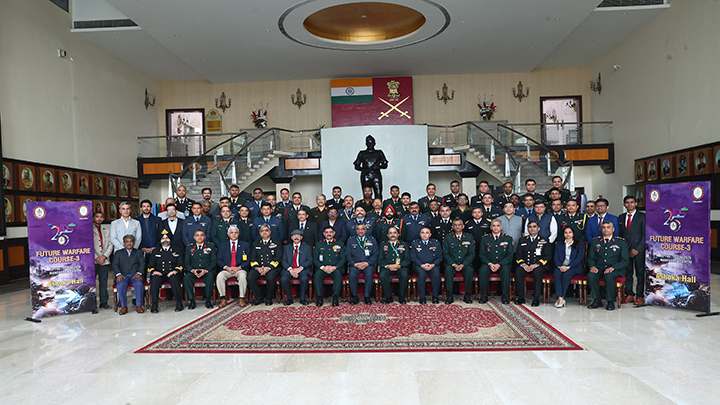
The third edition of the Tri-Services Future Warfare Course (FWC‑3) being held between 02 Feb and 25 Feb 2026 at the Manekshaw Centre, New Delhi, entered its Cognitive and Cyber Warfare module, a segment critical to understanding emerging domains of conflict and the evolving character of warfare. The module aligns with the overarching objective of the course, to equip officers with a comprehensive understanding of cyber, information, and cognitive warfare, and to foster operational foresight and adaptive thinking.

Air Marshal Ashutosh Dixit, Chief of Integrated Staff to the Chairman Chiefs of Staff Committee (CISC), in his address highlighted that the future conflicts will be increasingly shaped by cyber and cognitive dimensions, alongside conventional operations. He emphasized that military decision-making, operational planning, and strategic advantage will increasingly hinge on the ability to navigate complex information environments, counter adversarial influence campaigns, and employ digital and cognitive tools effectively. He further stressed that India’s preparedness in these domains is central to maintaining credible deterrence and operational superiority.
The multi-disciplinary composition of participants including Army, Navy, and Air Force officers, DRDO scientists, academia, and representatives from technology and defence industry partners facilitated a dynamic exchange of ideas. This environment encouraged participants to explore the integration of cognitive and cyber capabilities across multi-domain operations, and assess how emerging technologies such as AI, neural networks, and automated intelligence systems can be leveraged for operational advantage.
The inclusion of industry and academic experts highlighted the course’s emphasis on the synergy between operational requirements and technological innovation, ensuring that participants could gain insight into practical applications and technological trends relevant to national security. By combining theoretical frameworks, operational scenarios, and multi-domain perspectives, FWC‑3 ensures that participants are well-prepared to address both conventional and non-conventional threats in their professional roles.
FWC‑3 will proceed with subsequent modules on multi-domain operations, land, naval, and air warfare, culminating in scenario-building exercises and presentations on operational problem statements. The course’s comprehensive approach ensures that participants not only understand emerging threats but also develop actionable strategies to maintain India’s operational advantage in the evolving global security landscape.
