


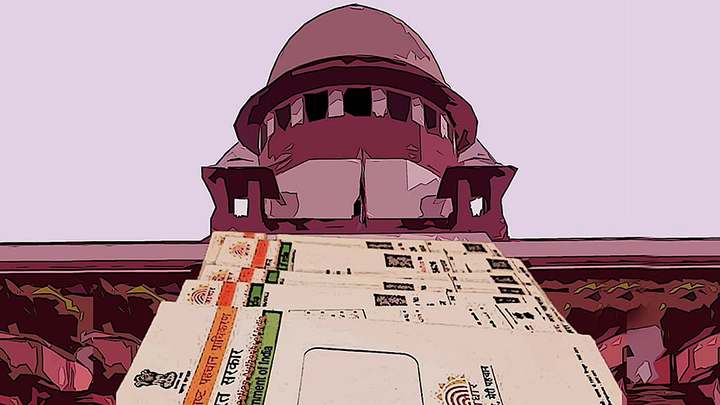
The petition seeks a court direction that Aadhaar is used only as proof of identity and not as proof of citizenship, domicile, address or date of birth.
JK News Today/Agencies
The Supreme Court on Tuesday sought the response of the Central and State governments as well as the Election Commission of India (ECI) on a petition seeking directions to ensure that Aadhaar is used solely as proof of identity and not as proof of citizenship, domicile, address or date of birth.

A Bench of Chief Justice of India (CJI) Surya Kant and Justice V Mohana issued notice on the petition filed by Advocate Ashwini Upadhyay.
The petition contends that the continued use of Aadhaar for purposes beyond identity verification is contrary to Section 9 of the Aadhaar Act, 2016. This provision states that Aadhaar is not evidence of citizenship or domicile.
The plea also relies on an August 2023 notification issued by the Unique Identification Authority of India (UIDAI), which clarifies that Aadhaar is proof of identity and not proof of citizenship, address or date of birth.
According to the plea, despite these statutory and regulatory restrictions on the scope of its use, Aadhaar is routinely accepted as proof of age, citizenship and domicile for various other purposes, including for school admissions, property transactions, issuance of birth certificates, ration cards and driving licences.
The petition specifically challenges the use of Aadhaar as proof of date of birth and residence in Form-6, the application form for fresh voter registration.
Upadhyay points out that the Aadhaar framework permits enrolment by all “residents”, including foreigners who have resided in India for at least 182 days in the preceding year.
Further Aadhaar enrolment can be facilitated through relatively simple documentation, such as with rent agreements or recommendations from local elected representatives. This, the plea claims, creates opportunities for “infiltrators and illegal immigrants” to obtain Aadhaar cards and subsequently secure other identity documents, including voter identity cards.
The petition alleges that such individuals are able to build a chain of official documents beginning with Aadhaar and extending to ration cards, birth certificates, domicile certificates and driving licences, enabling them to access welfare schemes and other benefits intended for Indian citizens.
It contends that this results in diversion of public resources, exclusion of genuine beneficiaries and undermines targeted welfare delivery.
“After obtaining 5-6 documents, infiltrators and illegal immigrants not only avail the welfare schemes of Centre and State Governments meant for economically weaker section but also enjoying the benefits meant for SC, ST, OBC and minority community,” the plea adds.
In particular, Upadhyay has raised concerns about the ramifications that such easy Aadhaar enrolment could have on the sanctity of elections in India, if Aadhaar is used to enable new voter registrations. He argues that illegal immigrants who obtain Aadhaar and other documents are eventually able to enrol as voters, thereby compromising the integrity of elections.
The plea further claims that such compromised voter rolls could also adversely affect voter delimitation exercises, potentially affecting the principle of equal representation in the Lok Sabha.
“Once, an infiltrator forges certain identity cards and subsequently the Voter-id Card, which is not difficult to do in a country affected by corruption, he becomes eligible to vote in the State elections. Therefore, the number of voters increase. As the number of voters increase, Delimitation of Constituencies is inadvertently affected,” the plea states.
In view of these concerns, Upadhyay has urged the Court to issue directions so that Aadhaar is used only as proof of identity in line with Section 9 of the Aadhaar Act and the UIDAI notification, and not as proof of citizenship, domicile, address or date of birth.
The plea also seeks a declaration that the acceptance of Aadhaar as proof of date of birth and residence in applications for new voter registration violates Section 9 of the Aadhaar Act, Section 23(4) of the Representation of the People Act, 1950 and Article 14 of the Constitution, and that such use would be void.
The petition has been drawn by Advocates Ashwini and Nikhil Upadhyay.
