


Hemani Kandhari
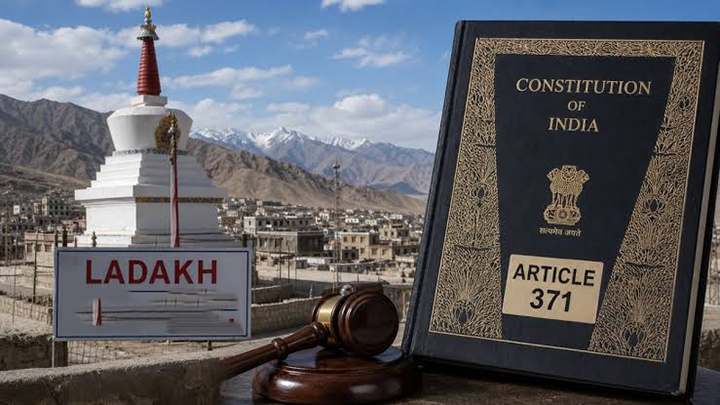
The Union Government has reiterated its commitment to providing constitutional safeguards for Ladakh under an Article 371-like framework, offering renewed hope to the people of the Union Territory and reinforcing confidence that the issue remains firmly on the national agenda.

According to reports emerging from discussions between the Ministry of Home Affairs and representatives of Ladakh, the Centre has clarified that constitutional safeguards for the region have not been abandoned. While certain concerns were raised regarding the minutes of the May 22 meeting, official sources have indicated that the Government of India remains committed to working out the precise scope, legislative framework, and operational details of the proposed safeguards.
The assurance assumes significance in light of the understanding reached during the May 22 talks, where Ladakh representatives and the Centre reportedly arrived at an in-principle consensus on a governance model that would provide constitutional protections on the lines of Article 371 provisions applicable in states such as Nagaland, Sikkim, and Mizoram. The proposal seeks to address Ladakh’s long-standing concerns relating to land, employment, culture, environment, and democratic representation.
One of the key aspects discussed during the negotiations was the creation of a Union Territory-level elected body with legislative, executive, and financial powers. The proposed framework also envisages greater accountability of the bureaucracy to the elected political leadership, a demand consistently raised by stakeholders in Ladakh. Reports suggest that the Centre has acknowledged the need for a governance structure that ensures democratic participation while preserving Ladakh’s unique identity and aspirations.
Ladakh Chief Secretary Ashish Kundra has on several occasions emphasized the importance of democratic consultation and engagement with all stakeholders. He has described the dialogue process as constructive and reaffirmed the administration’s commitment to addressing the aspirations of the people through consultation and consensus-building. His assurances have been viewed as an important bridge between the aspirations of the people and the ongoing discussions at the national level.
Since attaining Union Territory status in 2019, Ladakh has witnessed a broad-based movement led by social, political, religious, and civil society organizations seeking constitutional safeguards. The concerns stem from the need to protect the region’s fragile Himalayan ecology, safeguard local land ownership, ensure employment opportunities for residents, preserve cultural heritage, and strengthen democratic institutions.
The Centre’s latest reaffirmation sends a clear message that discussions are continuing and that efforts are underway to evolve a framework tailored to Ladakh’s unique circumstances. While finer legal and constitutional details remain to be worked out, the commitment expressed by New Delhi has revived optimism that a mutually acceptable solution is achievable.
With Parliament’s Monsoon Session approaching, expectations are growing that the momentum generated through recent discussions could translate into tangible progress. While constitutional and legislative processes often require time and extensive consultation, many in Ladakh view the Centre’s renewed assurance as a positive step towards securing long-awaited safeguards.
The road ahead may still involve further dialogue and refinement of proposals, but the message emerging from recent developments is encouraging: the Centre remains committed to providing constitutional protections for Ladakh, and hopes remain alive that the coming months could witness meaningful progress towards a framework that safeguards the region’s identity, interests, and future aspirations.
