


Pachen Charasa
The ongoing opposition to Ladakh’s new liquor policy has raised a question that many citizens are asking but few are willing to openly discuss:

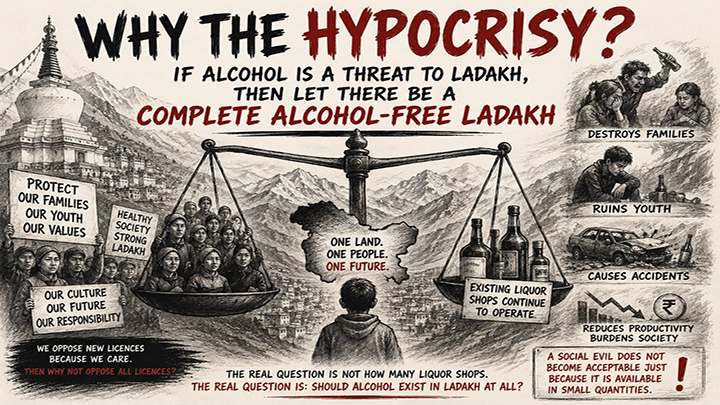
If alcohol is a social evil, why are the protests only against new licences and not against alcohol itself?
Over the past few weeks, several influential social, religious, and political organizations—including the Ladakh Buddhist Association (LBA), its youth wing, women’s groups, political representatives, and various organizations from both Leh and Kargil—have demanded the revocation of new liquor licences issued under the new policy.
Their concerns are familiar and understandable. Alcohol abuse can contribute to domestic violence, road accidents, family disputes, declining productivity, youth addiction, and broader social challenges. No responsible society can ignore these consequences.
However, this is where the contradiction begins.
If alcohol is genuinely viewed as harmful to society, then logic would suggest that the demand should be for a complete prohibition of alcohol in Ladakh. Yet most organizations opposing the new policy have stopped short of demanding a total ban. Existing liquor outlets continue to operate, alcohol continues to be legally sold, and consumers continue to purchase it.
The question therefore becomes unavoidable:
Why oppose new vendors while accepting existing ones?
Is the concern really about alcohol itself, or merely about who gets to sell it?
A social evil does not become less harmful simply because fewer people are licensed to distribute it. If alcohol is responsible for social damage, then that damage is caused by consumption, not by the number of licence holders.
This selective opposition creates an uncomfortable perception that the debate is not entirely about morality or public welfare. It raises concerns about whether the objective is social reform or the preservation of an existing market controlled by a limited number of vendors.
Particularly striking is the position of the Ladakh Buddhist Association and its youth wing. As the most influential Buddhist body in the region, the LBA frequently invokes Buddhist values and ethical principles in matters concerning society and culture. Buddhism clearly discourages intoxicants that cloud judgment and contribute to suffering.
If that principle is being applied consistently, then why has the organization not launched a movement demanding a complete alcohol-free Ladakh?
Why seek the cancellation of new licences while allowing existing liquor businesses to continue operating?
The same question applies to many other organizations participating in the agitation.
One notable exception has been the leadership of the VBL, whose president has not only opposed the liquor policy but has also publicly advocated for a total ban on alcohol in Ladakh. Whether one agrees with prohibition or not, such a position at least reflects consistency. If alcohol is considered harmful, then the logical conclusion is to eliminate its availability altogether rather than merely limit competition among sellers.
At the same time, Ladakh’s reality cannot be ignored.
Ladakh today is one of India’s most prominent tourism destinations. Every year, thousands of domestic and international visitors arrive seeking adventure, relaxation, cultural experiences, and respite from urban life. Many tourists, especially international travelers, expect access to alcoholic beverages as part of their personal lifestyle choices.
Moreover, Ladakh’s harsh climate and extreme winters have historically contributed to the consumption of various fermented beverages within local communities themselves. Whether one supports alcohol consumption or opposes it, the issue is far more complex than simple slogans.
This leaves Ladakh with two clear policy choices.
The first is to support a regulated system where alcohol is legally available under strict controls and transparent licensing.
The second is to pursue complete prohibition through a broad social consensus involving religious institutions, civil society groups, elected representatives, village bodies, and law enforcement agencies.
What appears intellectually inconsistent is advocating neither of these positions while simultaneously demanding that no new licences be issued but existing outlets remain untouched.
Ladakh deserves clarity.
If alcohol is a threat to society, then leaders should have the courage to demand a total ban and accept the practical consequences of such a decision.
If alcohol is not being prohibited because tourism realities, individual freedoms, and economic considerations make prohibition impractical, then the debate should shift toward responsible regulation rather than selective restrictions.
What Ladakh does not need is a policy position that condemns alcohol publicly while tolerating its continued sale privately.
The people of Ladakh deserve an honest conversation.
The real debate is not about new licences.
The real debate is whether alcohol should exist in Ladakh at all.
Until that question is answered honestly, the current agitation risks appearing less like a movement for social reform and more like a campaign rooted in selective morality.
