


Pachen Charasa
As discussions on constitutional safeguards for Ladakh continue and the Centre has once again reaffirmed its commitment to an Article 371-like framework, an important question deserves to be asked: what purpose do repeated bandh calls serve when dialogue remains ongoing and hopes for tangible progress in the upcoming Monsoon Session are alive?

More importantly, who is really paying the price for these bandhs?
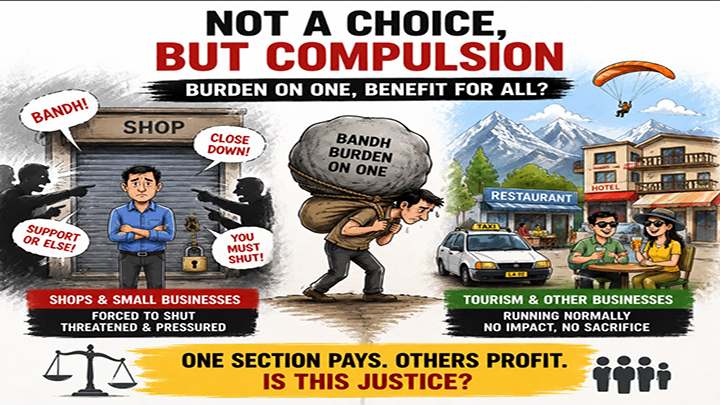
The reality on the ground is that many shopkeepers and small business owners do not participate out of choice but out of compulsion. The fear of social pressure, intimidation, and being singled out often leaves them with little option but to shut their establishments. This is particularly concerning when representative trade bodies and merchant associations have, on several occasions, expressed reservations about forced closures and the economic losses they inflict on ordinary traders.
A movement that claims to represent the aspirations of all Ladakhis cannot repeatedly place the burden on one section of society while others continue business as usual.
During bandh calls, hotels remain operational, tourism activities continue, taxis run, and many sectors connected to the tourism economy remain largely unaffected. Visitors continue to stay in accommodation facilities, tourism-related businesses continue to earn revenue, and economic activity in several sectors proceeds uninterrupted. Yet the primary impact falls on shopkeepers, daily wage earners, small traders, and local businesses whose livelihoods depend on each day’s earnings.
This raises a fundamental question of fairness. If a cause is truly collective, why should the economic sacrifice be selective?
The Centre has publicly stated that constitutional safeguards for Ladakh have not been abandoned. Discussions are continuing, consultations are ongoing, and proposals relating to land, employment, culture, environment, and democratic representation remain under consideration. Chief Secretary Ashish Kundra has also emphasized continued engagement and dialogue with stakeholders. At such a stage, constructive participation and consensus-building may serve Ladakh’s interests better than repeated disruptions that disproportionately affect ordinary citizens.
Democratic movements derive strength from public support, not from pressure tactics imposed upon vulnerable sections of society. The voice of Ladakh will be strongest when it is united, voluntary, and inclusive—not when the burden of protest falls repeatedly on the same group of people.
If sacrifices are to be made, they should be shared equally. If businesses are to close, the question must be asked whether all sectors are willing to bear the same cost. Otherwise, bandhs risk becoming less about collective action and more about selective hardship imposed on those least able to absorb it.
Ladakh deserves safeguards. Ladakh deserves dialogue. But Ladakh also deserves a movement that treats every citizen and every livelihood with equal respect.
