


Pachen Charasa
As Ladakh’s constitutional future enters another decisive phase, one of the sharpest internal critiques of the Apex Body Leh (ABL) and the Kargil Democratic Alliance (KDA) has come not from political opponents in New Delhi, but from within Ladakh itself.

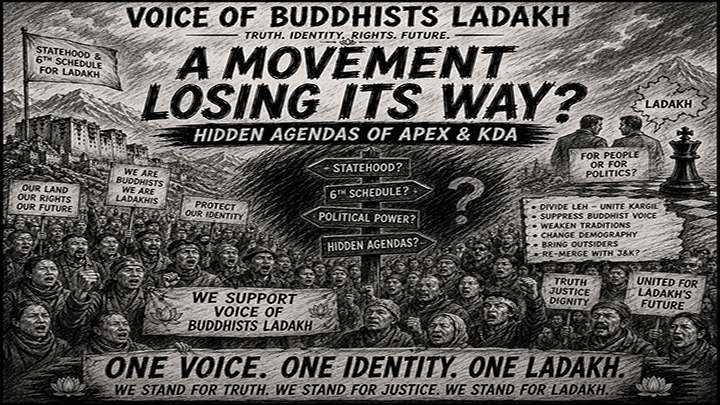
Voice of Buddhist Ladakh (VBL) founder Skarma Namtak has alleged that the campaign for Statehood and Sixth Schedule has evolved into something very different from what the people were originally asked to support. According to him, the movement has become less about achieving constitutional safeguards and more about sustaining a long-term political narrative.
Namtak argues that the contradiction lies in the leadership’s own messaging. On one hand, he says, representatives have described Statehood as nearly impossible—“like plucking stars from the sky.” On the other, they continue projecting Statehood and Sixth Schedule as lifelong political demands. He contends that this creates an endless cycle where aspirations are kept alive without presenting a practical roadmap to achieve them.
According to Namtak, this raises an uncomfortable question: Are these demands being pursued sincerely, or are they being preserved as permanent political slogans?
He further alleges that after Ladakh became a Union Territory in 2019, sections within the movement sought to create unnecessary confrontation between Leh and the Central Government despite the region’s historically cooperative relationship with New Delhi. In his view, repeated protests and agitations have served political objectives more than constitutional outcomes.
Perhaps his most politically explosive allegation concerns the 2024 Lok Sabha elections. Namtak claims that the mobilisation around Statehood and Sixth Schedule contributed to fragmenting Leh’s political landscape while consolidating Kargil, ultimately resulting in the defeat of Ladakh’s lone Buddhist parliamentary voice. He presents this as evidence that electoral calculations, rather than constitutional safeguards, have increasingly influenced the movement.
His criticism extends beyond electoral politics. Namtak accuses the leadership of drawing Leh’s youth into prolonged protests while, according to him, failing to create tangible opportunities or realistic solutions. He suggests that sustained agitation may have unintended social and professional consequences for young participants.
The VBL founder also voices concern over what he describes as attacks on Ladakh’s traditional Buddhist institutions and leadership. He argues that disparaging religious leaders and cultural institutions risks weakening the social fabric that has historically held Ladakh together.
Among his more controversial allegations is the claim that cultural identity itself is under pressure. He argues that traditional Ladakhi customs, including the greeting “Juley,” and broader Buddhist traditions are being gradually sidelined, though these claims remain matters of opinion and are likely to be strongly disputed.
Namtak further alleges that the movement has failed to adequately address long-standing concerns about outside commercial interests already operating in Leh’s historic market while simultaneously campaigning against potential future entrants. He describes this as an inconsistency that undermines public confidence.
His most serious political accusation is that certain elements within the movement ultimately seek outcomes that could weaken Ladakh’s distinct constitutional position, including what he characterises as attempts to revive discussions about re-associating Ladakh with Jammu and Kashmir. This is a significant allegation that has not been independently substantiated and would likely be rejected by the organisations concerned.
Whether one agrees with Namtak or not, his intervention reflects a growing debate within Ladakh over the direction of the constitutional movement. His central argument is that public trust cannot be sustained through symbolism alone. If constitutional safeguards remain the objective, he argues, the people deserve transparency, a realistic roadmap, measurable milestones and accountability from those claiming to speak on their behalf.
The Apex Body Leh and the Kargil Democratic Alliance have consistently maintained that they are working to secure constitutional protections for Ladakh through dialogue with the Government of India and have not publicly accepted the allegations outlined by Namtak. Ultimately, these competing narratives underscore the importance of informed public debate as Ladakh’s constitutional future continues to be negotiated.
