


By Pachen Charasa
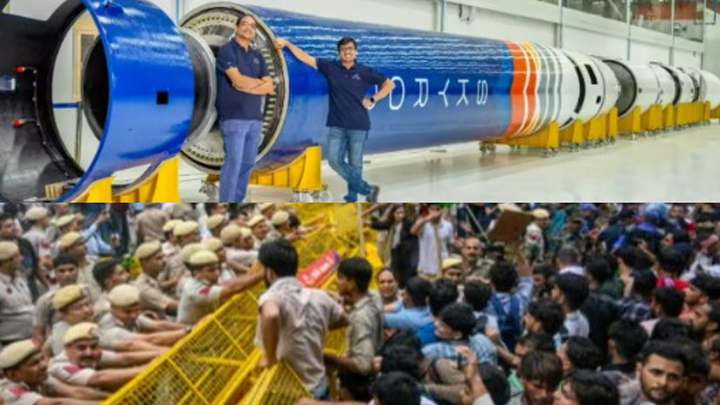
India witnessed two contrasting images within days of each other.

One image captured the aspirations of a nation. Young Indian engineers and entrepreneurs successfully launched a privately developed rocket into orbit, marking another milestone in India’s remarkable space journey. It was a celebration of innovation, perseverance, and scientific excellence.
The other image showed young people on the streets exercising their democratic right to protest. Peaceful protest is a constitutional right and an integral part of any vibrant democracy. Yet an uncomfortable question deserves to be asked: when political leaders and organisations become the most visible faces of a movement, whose cause is truly being advanced—the youth’s, or the politicians’?
The contrast is striking because India’s greatest successes have never come from abandoning challenges. They have come from confronting them.
The story of India’s first Satellite Launch Vehicle (SLV-3) remains one of the finest lessons in leadership and nation-building. Under the chairmanship of Prof. Satish Dhawan, Dr. A.P.J. Abdul Kalam led the ambitious programme to place an Indian satellite into orbit. In 1979, the mission failed, and the launch vehicle fell into the Bay of Bengal.
It was a national disappointment.
The media demanded accountability. Critics questioned the programme.
Prof. Satish Dhawan walked before the cameras and accepted complete responsibility. He neither blamed his scientists nor sacrificed anyone to satisfy public outrage. Instead, he protected his team, encouraged rigorous analysis of every technical failure, and ensured that the setback became a classroom rather than a courtroom.
A year later, the SLV-3 successfully placed the Rohini satellite into orbit. This time, Prof. Dhawan asked Dr. Kalam to face the media and receive the applause.
That single episode became a defining example of leadership: responsibility in failure, generosity in success.
Today’s India stands on the shoulders of that culture.
The recent success of India’s private space sector is not an isolated achievement. It is the outcome of decades of scientific investment, institutional confidence, and a national mindset that viewed failure as a stepping stone rather than a reason to abandon the mission.
Unfortunately, a different culture is also emerging in sections of public life.
Young people unquestionably have every constitutional right to raise concerns, question governments, and organise peaceful demonstrations. Democracies become stronger when citizens participate responsibly.
But participation should never mean surrendering independent judgment.
Whenever protests become visibly dominated by political parties, career politicians, or organisations pursuing partisan objectives, young participants should pause and ask difficult questions. Who is setting the agenda? Who benefits from prolonging the confrontation? Is the movement still driven by genuine public concerns, or has it become a platform for political mobilisation?
History repeatedly shows that political actors often seek legitimacy by standing beside popular causes. There is nothing inherently wrong with political participation in public movements. The problem arises when citizens cease to distinguish between their own aspirations and the ambitions of those leading from the stage.
Democracy requires informed citizens, not political followers.
India’s youth deserve better than becoming foot soldiers in someone else’s political campaign. They deserve to become scientists, entrepreneurs, innovators, educators, soldiers, artists, and leaders who solve problems instead of merely amplifying divisions.
The lesson from Dr. Kalam and Prof. Satish Dhawan is as relevant today as it was nearly five decades ago. Real progress comes from accepting responsibility, learning from setbacks, and building institutions—not from allowing every public grievance to become another arena for political spectacle.
The India that inspires the world is not the India that shouts the loudest. It is the India that builds, invents, and perseveres.
Our youth must decide which legacy they wish to inherit: the legacy of those who turned failure into orbit, or the legacy of those who allow political interests to define their voice.
