


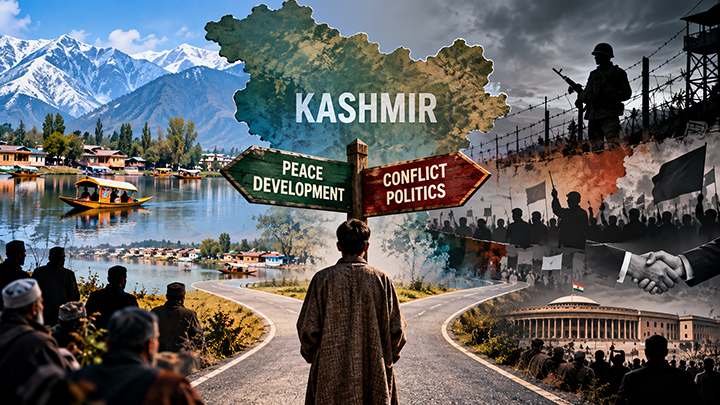

“Kashmir is at a crossroads” is a term that history has permanently tagged to this region. The place remains at the center of controversies and political upheavals, a label that has refused to fade away despite massive changes in the landscape and a rapid pace of events. Over the centuries, every shift in the region and every change in attitude toward its people has only complicated its history and deepened its fault lines. Meanwhile, certain sections of the country consistently assume that Kashmir has been favored or pampered more than other states.
Caught between this so-called appeasement and outright hostility, what is lost is that there have rarely been genuine attempts to understand the region. Perhaps the original fault lies with the people of this beautiful land themselves, who have presented and articulated conflicting shades and voices regarding their identity. They have always struggled to balance their frustrations against their aspirations—specifically vis-à-vis Delhi. The connotations of “Delhi” in Kashmir are entirely different from the normal prism of it simply being the headquarters of federal power. In Kashmir, Delhi connotes India. The Government of India is not seen merely as a federal entity, but as the nation itself. This perception has not changed to this day.
Quite often, voices from the Valley point out that its people once had the option to join Pakistan because of its vast Muslim majority, yet their leadership opted for India. This raises two critical questions: are they appreciating their historical leadership for choosing India over Pakistan as their destiny, or have they come to regret it? If it is the latter, they are damning their own leadership and the decisions taken at a critical turning point in history.
They are not oblivious to what Pakistan is currently undergoing—how its people are treated and how they are forced to demand basic necessities. Kashmir itself witnessed how Pakistan was split in two, and it can see that the process of its balkanisation is still rolling on. There is a clear argument to be made that the territories of mainland Pakistan could not stay together, with Bangladesh serving as a glaring example. Furthermore, the atrocities that the Pakistani establishment is committing in Balochistan, Khyber Pakhtunkhwa, and even in Pakistan-occupied Jammu and Kashmir (PoJK) have thoroughly exposed the mindset with which Pakistan was created. It was not formed to provide Muslims with a separate nation to serve them, but to rule over them in the most ruthless manner. Pakistan’s history bears remarkable testimony to this fact.
Beyond that, one must look at how many opportunities Kashmir—on this side of the Line of Control (LoC)—has missed, causing generational damage. The Kashmiri Muslim leadership, which is arguably as divided as it could possibly be, never attempted to sit down together and decide on the best way forward. Dragging Pakistan into the narrative, whether out of political compulsion or emotional exploitation, did more damage to the Valley than anything else. Had they chosen a different path, perhaps Kashmir would be in a very different position within the Indian Union today. At the very least, there would be no current fight for the return of statehood.
Delhi, both in the past and perhaps even today, has maintained doubts over the Kashmiri leadership, which is precisely why the region remains stuck where it is. These fractured narratives have given an advantage to those who water the seeds of suspicion and mistrust between Delhi and Srinagar. They are having the best of times because all they need to do is pick choice words, phrases, and geopolitical connotations to convince Delhi that these local leaders are trying to revert to the era of 1947. This creates a historical crisis, because moving forward is somehow branded as “anti-Kashmir.”
The choice made in 1947 is a done deal. This is true not just because Maharaja Hari Singh acceded the entirety of the Princely State to India, but also because the majority of the people bowed to the political wisdom of Sheikh Abdullah and agreed it was the right decision. It was a conscious choice by the people, read in conjunction with the signing of the Instrument of Accession by the last Dogra king after Pakistan-sponsored tribesmen rampaged through Kashmir. For whatever reason—be it a historical blunder or something else—several territories of the state remain with Pakistan. This is exactly where the importance of the Instrument of Accession comes into play, because the territories under Pakistani control are illegally occupied.
Eighty years have passed since Jammu and Kashmir became part of India. Today, re-invoking the past looks not only odd but acts as a manifestation of a split mindset. It is entirely contradictory to term Pakistan’s 1947 invasion as atrocious—where tribesmen not only looted homes but unleashed horrific trauma by subjecting young women to their lust—while simultaneously re-invoking the options the region had in 1947. Doing so completely falsifies the entire thesis of conviction. It gives rise to two sets of doubts: first, that the endorsement of the accession to India was born less out of political and anthropological conviction and more out of temporary political convenience; and second, that repeatedly referring to the most controversial part of history only helps those who do not want Delhi to trust Kashmir. This is a far wider dimension than is currently understood.
Following the exodus of the Kashmiri Pandits and the chaos that ensued, Kashmiri Muslim leaders should have charted a clear pathway to change this damning narrative and halt the damage being done to their image. They were the ones equipped to do it—there is no dearth of political wisdom among them. They could have become the chief architects of their region, helping future generations become brand ambassadors for everything positive that Kashmir represents.
In September 2006, almost a year after the devastating earthquake that struck Kashmir on both sides of the LoC, a resident of Muzaffarabad, Mir Afzal Suleri, told the US-based Human Rights Watch: “Pakistan says they are our friends and India is our enemy. I agree India is our enemy, but with friends like these, who needs enemies?”
That is the reality of Pakistan, a reality that can only be ignored at our own peril. Kashmir needs a clear view ahead, not friends like these. They can never be friends to anyone.
