

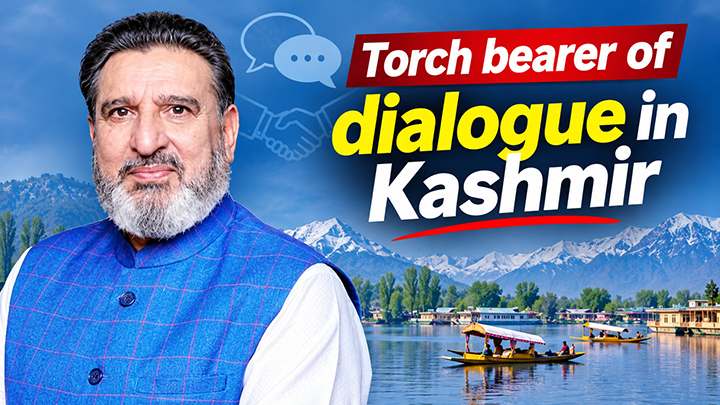
Altaf Bukhari’s relentless push for Centre-J&K dialogue resonates at PDP rally
JK News Today News Analysis
Srinagar: A foundational shift that founder of Apni Party Altaf Bukhari had suggested and urged the country’s leadership within months after the abrogation of Article 370—to be precise, in March 2020—was that it should open a dialogue with the people of Jammu and Kashmir, who had become voiceless because they had put a finger on their lips. They had chosen silence over the risks of speaking out, lest their words be misunderstood or misinterpreted, which might invite reprisals. This is history.
Through pleadings and hard negotiation, presenting the plight of the people in a frame that could have made it embarrassing for Delhi, Altaf Bukhari urged the leadership that public dialogue alone can address the real-time grievances of the people, who were reeling under a perception that their identity and dignity were under threat. They needed an outlet that could help the Centre to advance its goal of lasting peace in Jammu and Kashmir—which was struggling to come out of a decades-long violent chokehold of bullets and stone-throwing—and that outlet was in the hands of Delhi. He infused a trust-building clarity into the minds of the people of Kashmir and the Modi government at the Centre.
The GoI saw merit in this logic, as it could help shape policy toward the people of J&K to end the sense of uncertainty that had come to grip them. Prime Minister Narendra Modi convened an all-party meeting on June 24, 2021. That meeting concluded with a profoundly forward-looking message delivered by the Prime Minister: “We will work to end distances between hearts and minds, between the people of Kashmir and Delhi.” That generated a sense of hope that was further upped by Union Home Minister Amit Shah.
However, that public dialogue with the youth and others is still being awaited. Altaf Bukhari did not give up; he persisted and continued to remind and appeal to the national leadership to talk to the people of J&K, who deserved attention not only for their development needs but also needed an audience and a response from the Government. This was the simplest promise to fulfil because it did not require any constitutional change nor any resolution to be adopted in the parliament. It was at the core of the ethos of India, the largest democracy in the world.
Even when the RSS started suggesting to the Centre that it should open a dialogue with Pakistan, arguing that relations with the neighbouring country could not stay frozen forever and that the locks needed to be opened, the Apni Party and its leaders—especially Bukhari and G. H. Mir, senior vice president of the party—maintained, “It is the prerogative of the Centre to talk to Pakistan or not, but the inevitability and necessity of talking to J&K people cannot be overlooked.”
The same message was made to Delhi by Mehbooba Mufti, a familiar figure in Kashmir politics as head of the People’s Democratic Party (PDP) and first woman chief minister of J&K, at her party workers’ convention in Srinagar on Monday. She told Delhi that you cannot resolve problems in Kashmir through UAPA, PSA, or throwing employees out of jobs, but only by talking to the people. “That’s the way out.”
The trend that Altaf Bukhari and the Apni Party set six years ago is resonating now—the realistic channel that can help give a sense to the people of J&K that Delhi cares. Delhi needs to respond to this spirit and give thumbs up to ideology of dialogue .