

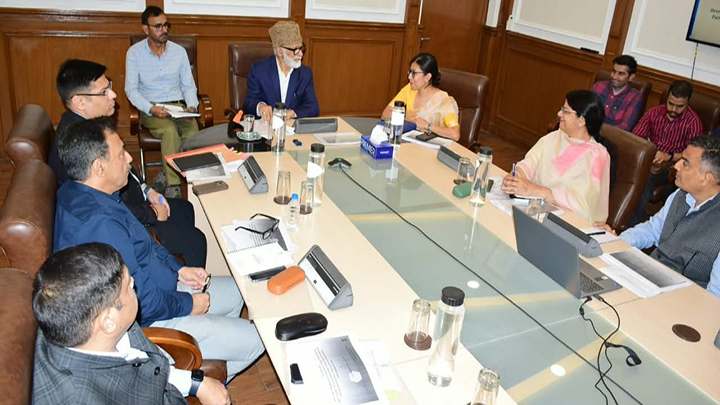
Advocates scientific preservation of historical documents, filling of grassroots level vacancies
JK News Today
JAMMU, NOVEMBER 3: Minister for Revenue, Power Development Department, Law, Disaster Management, Relief, Rehabilitation and Reconstruction (DMRRR) and Elections, Ali Mohammad Sagar, today emphasised upon the Revenue Department to expedite the process of digitisation and verification of land records.
Sagar stressed on making the Settlement Wing fully functional and strengthening the revenue administration at the grassroots level. He directed for ensuring scientific preservation of historical revenue documents. He called for a time-bound action plan to address the infrastructure and manpower deficiencies, particularly in remote and far-flung areas. He directed the officers to ensure transparent, accessible and hassle-free delivery of revenue services to the public.
Speaking at a review meeting of the Revenue Department, the Minister stressed that digitisation must be backed by proper verification and authentication of records, adequate field-level infrastructure and effective monitoring so that the ongoing reforms translate into tangible benefits for the citizens. He directed the officers to strengthen coordination with elected representatives and establish an effective mechanism for addressing public grievances and area-specific problems.
The meeting was attended by Secretary, Revenue, Avny Lavasa; Divisional Commissioners; Deputy Commissioners; Custodian General; Inspector General of Registration; Additional Deputy Commissioners; Assistant Commissioners Revenue (ACRs); Tehsildars and other senior and field-level officers of the department.
During the meeting, the Minister undertook a detailed assessment of various aspects of revenue administration, with focus on digitisation of land records, settlement operations, preservation of historical revenue documents, strengthening of field-level infrastructure, manpower requirements and streamlining of citizen services.
Emphasising that modernisation of the Revenue Department must translate into tangible benefits for the common people, Sagar stressed that digitisation should not be confined to mere conversion of physical records into electronic formats. Instead, it must ensure accuracy, authenticity, transparency and easy accessibility of land records thereby reducing procedural delays and eliminating unnecessary hardships for citizens.
He underscored the need to strengthen the grassroots revenue administration, particularly in remote and far-flung areas, where inadequate infrastructure, electricity supply, internet connectivity, computers and other essential technical facilities continue to impede the digitisation process. He stressed that every Patwar Halqa must be equipped with the requisite electronic infrastructure to ensure that people in even the remotest areas can access digital revenue services without difficulty.
The Minister also called for making the Settlement Wing fully functional and operational, observing that settlement activities must progress simultaneously with digitisation. He emphasised the importance of proper verification, authentication, updating and reconciliation of land records to ensure that digitised data is accurate and free from discrepancies.
Taking note of the condition of historical revenue records, Sagar called for strengthening Mahafiz Khanas with adequate infrastructure, trained manpower and modern preservation facilities to safeguard valuable historical documents, including Lathas, Jamabandis, Massavis and other traditional revenue records.
The issue of missing, damaged, incomplete and untraceable revenue records also figured prominently during the deliberations.
The Minister stressed the need for a systematic, transparent and time-bound mechanism to identify, retrieve and reconstruct such records through authentic historical references, settlement documents and other verifiable sources. He made it clear that no unverified or unauthenticated entries should find their way into digitised land records.
On the manpower front, the Minister emphasised the need to address staff shortages at the grassroots level, particularly at the Patwari, Girdawar and Naib Tehsildar level. He observed that strengthening the administrative structure at the Tehsildar level alone would not serve the intended purpose unless adequate supporting manpower was also available in the field. He also stressed the need for proper office accommodation and essential facilities in Patwar and Girdawar Khanas, especially in underserved and remote areas.
Reviewing the delivery of routine revenue services, Sagar called for timely mutation entries, correction of discrepancies, maintenance of updated records and an effective grievance-redressal mechanism. He stressed that citizens must not be made to undertake repeated visits to government offices or face avoidable delays while obtaining essential revenue documents and services.
The Minister also underlined the importance of institutionalising regular consultation and coordination with MLAs, elected representatives and other public stakeholders. He said their active involvement was essential in identifying area-specific issues relating to disputed and missing land records, settlement operations, infrastructure deficiencies, manpower shortages and public grievances.
Sagar stressed that the benefits of ongoing reforms must reach ordinary citizens, particularly those living in remote and far-flung areas, through simplified procedures and time-bound delivery of services.