


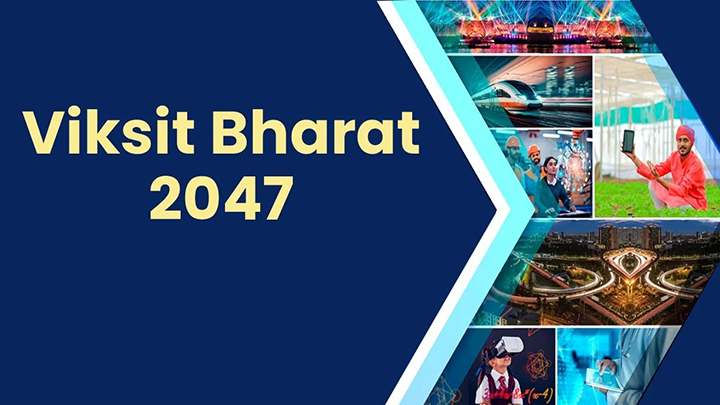
A couple of days ago, while speaking on completion of twenty five years of his Rule, termed as ‘Public Service’, initially as Chief Minister of Gujrat and then as Prime Minister of India, Prime Minister Narendra Modi, gave a new slogan of hope to the country “We will do it” reiterating his commitment made to the nation that India would be a developed country by 2047. He had made a somewhat similar statement while attending the SCO Meeting in Krgystan in his social media message on X, and congratulated the entire country for achieving 7.8% growth rate despite numerous international and national challenges. He repeated the same in his address to the Sri Ram College of Commerce students in Delhi, a couple of days later and said that despite the doomsayers negating Indian growth story, the future seems to be bright if the country continues to progress at this speed as the country has moved from Policy paralysis to Policy Dynamism. He had credited the strong economic numbers to the hard work, determination, and collective resolve of 1.4 billion citizens. His words and advice attract criticism from opposition parties, from those intending to harm India including the foreign powers inimical to or competing with India and has made some impact on thinking mechanisms of many but a lot is expected from the civil society.
By present yardsticks of growth, India can become the third largest economy in the world sooner than expected and though this may be giving sleepless nights to our adversaries and jealous well wishers as well. The country as a whole, irrespective of our political and social thoughts, our religion, our castes, our ways of approaching the challenges, continues to progress bringing cheers to the lives of millions, who have benefitted from the progress. If we have to achieve the targets, we must come together, appreciate and rejoice the achievement of all those who have contributed in the giant stride of last few years and strive for bigger the picture. But there is another danger looming large, which needs immediate and adequate response, to which not many in the country have given much attention. It is our inability to make the country to retain its civilizational roots while achieving success at economic and scientific levels.
The real question, therefore, is not whether India should progress, and leaving aside the cynics, even the bitter critics of Mr. Modi will have no qualms for this vision of India. But we need to ponder as to what kind of progress we want and what kind of Indians we want that progress to produce. A developed India cannot merely mean achieving a number three position in the world rankings, or higher per capita income, modern cities, advanced technology, larger highways, bigger buildings and greater consumption. Developed India must mean much more; the development of the mind, character, social responsibility and moral consciousness of the citizens of India should be the end goal. We would be civilizationally vulnerable if material prosperity is achieved at the cost of our values, social harmony and cultural self-confidence though we may become economically powerful. ‘Viksit Bharat’ should entail something more, the Gen Zee having a developed mind capable of using modern knowledge without becoming a prisoner of every idea imported in the name of modernity.
This is where India needs to pay much greater attention to the ideological and intellectual formation of its young generation but we are lagging in this field. The youth of futuristic India, like in many other parts of world, will have natural inclination towards progress, opportunities in western world, technology, individual freedom, and scientific inquiry and there is nothing wrong with these aspirations. The danger would arise when progress would be presented as synonymous with the wholesale abandonment of our own philosophical foundations. A blind following of Western thought processes, merely because they appear to be natural ally of progress and prosperity, can gradually create a generation, as witnessed during CJP protests in Delhi a few months ago who have no regard for our values and no respect for elders displaying open hatred for the country and not hesitating to create chaos and lawlessness. We are progressing to create a generation that knows how to consume the products of modern civilization but has little understanding of the civilization that shaped its distinct identity. Such a situation can weaken our distinctiveness and eventually create an intellectual dependence that is more serious than economic dependence.
But mere rejection of Western knowledge is also not the solution which would be equally misplaced. Science, technology, constitutional values, modern management, entrepreneurship and the best achievements of global civilization should be integrated and welcomed and integration is different from imitation. Our approach should be like that of a honey bee; take what is useful from any flower, test it and develop solutions that are consistent with our civilizational experience. Examination, adaptation and then assimilation of the best should be the buzzword in the modern India.
We have a remarkably rich intellectual framework for undertaking this task through our own philosophical traditions. ‘Sankhya’ and ‘Yoga’ philosophies provide a way of understanding the relationship between consciousness, mind, nature, the qualities that influence human behavior and a practical way for regulating the mind and transforming destructive tendencies. The concepts of ‘Sanskars’ and ‘Vritti” as per those Sanskars, is not found in any other part of the world. These are not merely subjects for historical study or attaining better health. They can be examined, researched and translated into contemporary programmes for education, mental discipline, crime prevention, leadership, social responsibility and behavioural transformation.
This is also central to the ideas advanced through ‘Yogic Crime Theory’. If destructive tendencies can be identified, understood and gradually transformed through appropriate education, discipline, environment and behavioural interventions, and prevention becomes possible before the individual crosses the boundary into serious deviance. The same principle has a much wider application. If we want responsible citizens, innovative entrepreneurs, ethical professionals and socially conscious leaders, we have to work on the formation and transformation of the mind, not merely on the acquisition of information.
The education system therefore has to become one of the principal instruments of this civilizational renewal. Young Indians need to be encouraged to study mathematics, artificial intelligence, biotechnology, economics and global affairs, but they should simultaneously understand the intellectual heritage of India, the teachings of the Bhagwad Gita, the great traditions of literature, statecraft, medicine, ecology and social organization. This way the young generation would get the intellectual access to the ideas that have historically shaped the Indian understanding of duty, self-control, compassion, coexistence, responsibility and the relationship between the individual and society.
The same principle must guide our understanding of economic development. Atmanirbhar Bharat should not remain confined to manufacturing or purchasing domestic products. Self-reliance should also mean intellectual self-reliance and cultural self-confidence. We should be capable of creating Indian solutions to Indian problems. Solutions for Terrorism, Naxalism, crime, addiction, social conflict, environmental degradation, waste management, family disintegration and youth alienation must come by combining modern scientific research with the wisdom available within our own philosophical traditions. Proposals for behavioural transformation and prevention are based on precisely this premise; the answer to every modern problem need not necessarily be imported when our own civilization contains conceptual tools that can be subjected to scientific scrutiny and developed further.
The challenge before India, therefore is to create a synthesis rather than a confrontation between tradition and modernity. We must produce a country that can reshape the world order and can conduct global business with all. We need citizens who can compete confidently with the world without feeling culturally inferior to it.
Viksit Bharat 2047 should consequently be measured by more than GDP, rankings and infrastructure. We should ask ourselves; where our children are heading to. Progress without values can produce powerful societies, but progress guided by values can produce enduring civilizations. India’s distinctive opportunity is to demonstrate that modernization need not require deracination.
We need not turn backwards. The solutions to the challenges of the twenty-first century must emerge from a dialogue between modern knowledge and India’s own thought processes, philosophy and sanskars. If we succeed in doing this, Viksit Bharat will not merely be a richer India. It will be an India which is intellectually confident, socially responsible, culturally distinctive and psychologically strong; an India that progresses without forgetting what it was and where it wants to be.
…………………………………………………………………………………………………………………….
The author is a practicing Advocate of J&K High Court and President of the Criminologists Society.
