


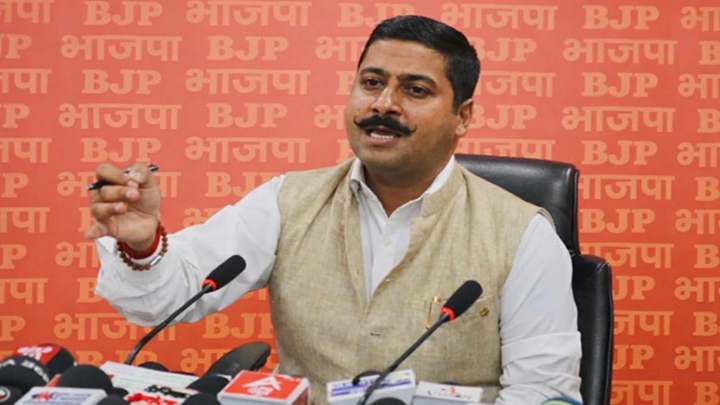
“Memoir” can’t hide Congress’s failures: Gaurav
JK News Today
JAMMU: BJP Spokesperson and Convenor International Affairs, Gaurav Gupta, launched a sharp attack on former Congress president Sonia Gandhi over the release of her memoir Belonging: A Journey of Love, questioning the selective presentation of history and alleging that the Nehru-Gandhi family continues to avoid accountability for the Congress party’s controversial political and governance record.

Reacting to the memoir, Gupta said that personal experiences and family memories cannot substitute for an honest examination of the decisions, policies and failures that shaped India’s political history.
He said, “Sonia Gandhi may choose to narrate her personal journey through the pages of a memoir, but the people of India have their own memories of the Congress era. No book, however carefully written, can erase the Emergency, the curtailment of democratic freedoms, corruption controversies, policy failures and the repeated erosion of public trust during Congress rule.”
Taking aim at the Congress leadership, Gupta said that the real question is not what Sonia Gandhi wishes to remember, but what the country expects her and her party to answer.
He pointed to the Emergency of 1975, when fundamental rights were suspended, political opponents were jailed and press freedom was curtailed. He said that describing the Emergency as a mistake cannot be a substitute for accepting the institutional damage and democratic consequences of that period.
Gupta further questioned the Congress leadership’s record during the UPA years, referring to major corruption controversies surrounding the 2G spectrum allocation, Commonwealth Games and coal block allocations.
He said these controversies raised serious questions about transparency, accountability and the functioning of government. He added that the country witnessed a period in which allegations of corruption and policy paralysis became central to the national political discourse.
“People have not forgotten the allegations of scams, the controversies surrounding public resources and the political culture that allowed corruption allegations to dominate national headlines. The Congress must answer for its record instead of expecting citizens to accept a sanitised version of history,” Gupta remarked.
Describing the alleged misuse of public trust as a form of political dacoity, Gupta said that public resources belong to the people and governments are merely their custodians.
He also questioned the Congress leadership’s moral positioning on matters of national security and communal harmony, referring to the 1984 anti-Sikh violence and the 26/11 Mumbai terror attacks. He said that any honest account of India’s political history must address the suffering of victims and the accountability of those in positions of authority.
Gupta also raised questions about the book’s treatment of the Emergency and other contentious chapters of Congress history.
Gupta said, “The Congress cannot selectively invoke democracy, constitutional values and secularism while avoiding difficult questions about its own past. Accountability must be consistent, not selective. India’s history belongs to its people, not to any political family.”
He further said that under Prime Minister Narendra Modi’s leadership, the BJP government has emphasised transparency, accountability, development and decisive governance, adding that the electorate has repeatedly demonstrated its expectation of performance and responsibility from those holding public office.
Concluding his remarks, Gupta said that India’s democracy is larger than any political dynasty and no individual or family can claim ownership over the country’s political narrative.
“History is not rewritten through memoirs or public relations exercises. It is remembered through the experiences of millions of citizens. The Congress must answer for its record rather than attempt to whitewash it,” Gupta asserted.
