


Questions repeated rotten meat seizures, serious gaps in food safety enforcement; calls for transparent investigations, stronger monitoring and greater investment in local food production
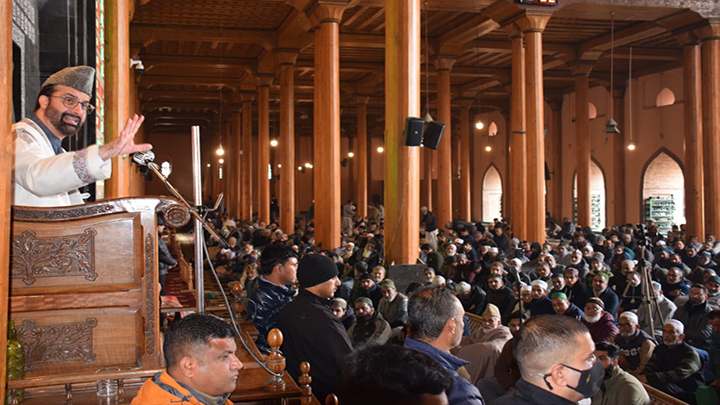
Srinagar, November 20, 2026: Addressing the Friday congregation at the historic Jama Masjid Srinagar, Mirwaiz-e-Kashmir Dr Moulvi Mohammad Umar Farooq today expressed grave concern over repeated incidents of food adulteration and the seizure of large quantities of rotten meat, describing them as deeply disturbing and reflective of serious shortcomings in public accountability and societal ethics.
Mirwaiz said that the Muttahida Majlis-e-Ulama (MMU) had devoted today’s common Friday Khutbah, delivered in mosques across Jammu, Kashmir and Ladakh, to “Food Adulteration, Moral Decline and Collective Responsibility.” Referring to the Quranic injunction of Halal and Tayyib, he said Islam requires food to be not merely lawful but also pure, wholesome and safe for consumption.

Referring to the recent seizure of approximately 2,000 kg of rotten meat at Budgam Railway Station, reportedly transported from Delhi Mirwaiz appreciated the intervention of the Railway Police but questioned how such a huge quantity of a perishable commodity could travel hundreds of kilometres without any safe guards and so easily ?
“Who sent this meat, who was supposed to receive it in Kashmir, and where was it intended to be distributed? Were the consignments transported under their correct description, and why were the mandatory checks not carried out?” he asked.
Demanding a transparent investigation into the entire supply chain, Mirwaiz stressed that merely seizing and destroying rotten meat was not enough. Those found responsible must be held accountable, exposed and punished .
Mirwaiz demanded to know what happened to the previous inquiry after thousands kilograms of rotten meat was seized last year and send to forensic lab for testing . Promises were made that after investigation the findings will be made public and the culprits brought to book . Why happened to that inquiry and where is its report ?
Citing figures presented in the Legislative Assembly, he said over 12,183 kg of rotten meat had been destroyed during 2025–26 up to December 2025, while 7,665 kg of substandard paneer had also been seized in Jammu and Samba. Such recurring incidents, he said, were creating widespread anxiety , eroding public confidence in food safety.
Expressing concern over serious deficiencies in food safety enforcement, Mirwaiz referred to reports indicating that only 68 Food Safety Officers serve across J&K’s 20 districts. In the two food-testing laboratories, 11 of the 19 sanctioned technical positions in each are reportedly vacant, while 12 mobile food-testing vehicles are reportedly not functioning effectively due to staff shortages, despite earlier official claims of their operational status.
“How can public health be safeguarded when the very institutions responsible for food testing and monitoring face such serious shortages?” he asked, urging the government to fill vacancies, strengthen laboratories, operationalise mobile testing facilities and ensure regular inspections of markets, railway consignments and food transportation.
Mirwaiz also voiced concern over growing public apprehension regarding the authenticity of Halal meat brought from outside, calling for transparent verification of its source, slaughtering practices and certification. He said the prevailing uncertainty was also hurting restaurants, hotels and the wider hospitality sector.
Emphasising the need for local self-sufficiency, Mirwaiz questioned Kashmir’s heavy dependence on outside markets for meat and other essential food supplies. Referring to youth unemployment of 26.2% in J&K, against the national average of 15.3%, he urged the government to promote sheep farming, poultry and allied enterprises through financial assistance, training and market support, creating opportunities for young people while strengthening local production.
Turning to the moral dimension, Mirwaiz questioned the growing tendency to place profit above human health.
“What kind of society are we becoming if some among us are prepared to endanger the lives of others for extra profit? Where are our values of honesty, compassion, accountability and fear of Allah?” he asked.
Mirwaiz stressed that the responsibility for restoring public trust rested with the government and business community but also with the society. It is people who make up the society and if we indulge in such practices for profit the responsibility lies equally with us .
While we need accountability from the authorities, we need honesty from our business community and moral uprightness from our society. We must not only ensure that our food is free from adulteration, but also strive to rid the society of greed, dishonesty and moral decay,” Mirwaiz said.
