


An opinion article on Ladakh’s journey since 2019, the legacy of decades of neglect, and the new era of development under the BJP-led government.
Rigzin Phyang
November 27, 2026: For decades, Ladakh remained a region of immense strategic importance, extraordinary natural beauty and rich cultural heritage, yet its development aspirations often remained confined to promises and political speeches. Despite its contribution to the nation, the people of Ladakh continued to struggle with limited infrastructure, difficult connectivity, inadequate healthcare facilities and a lack of opportunities for young people.
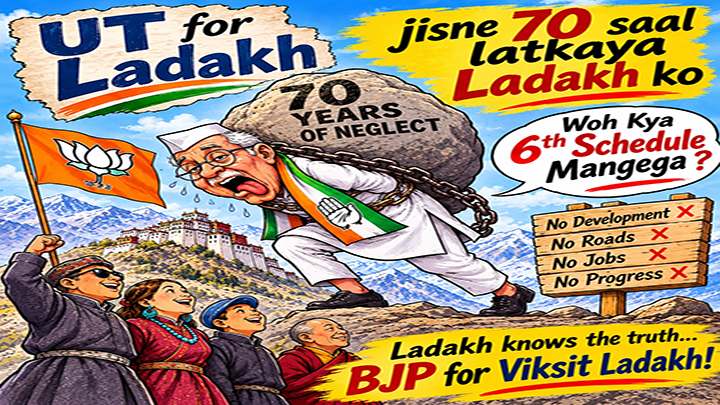
The political message reflected in the illustration is sharp and unmistakable: those who kept Ladakh waiting for decades cannot suddenly claim to be its champions of constitutional safeguards and development.

The creation of the Union Territory of Ladakh on 31 October 2019 marked a historic turning point. It was not merely an administrative change; it was the fulfilment of a long-standing aspiration for a distinct identity, greater administrative attention and a development model responsive to Ladakh’s unique geographical and social realities.
The UT Era: A New Chapter of Development
Since becoming a Union Territory, Ladakh has witnessed a visible change in the pace and scale of development. The region has increasingly become a priority in national planning, infrastructure investment and governance.
The transformation is reflected in several important indicators. According to figures presented by the Government of India, Ladakh’s road network has expanded from approximately 1,800 kilometres in 2019 to more than 4,000 kilometres. The number of major bridges has increased from 19 to nearly 75, while helipads have grown from seven to more than 40. Household tap-water coverage has risen from around 3.5 per cent to nearly 99 per cent, and hospital bed capacity has approximately doubled.
These are not merely statistics on government documents. They represent a change in the everyday lives of ordinary Ladakhis.
A road reaching a remote village means access to markets, schools and hospitals. Reliable electricity means better education for children and greater possibilities for local enterprises. Improved healthcare infrastructure means that families may increasingly receive treatment closer to home. Better connectivity opens new avenues for tourism, agriculture and employment.
The ongoing progress of the Zojila Tunnel is another symbol of this transformation. For a region where winter isolation has historically been a major challenge, improved all-weather connectivity represents far more than an engineering achievement—it represents hope, security and economic opportunity.
Development Reaching the Last Mile
The real test of development is not how much is announced in Leh or Kargil, but how much reaches the farthest village.
From improved roads and mobile connectivity to solar energy, drinking water, healthcare and modern educational facilities, the post-UT period has brought renewed attention to the needs of remote and border areas.
The progress visible in villages such as Fotoksar, and the growing focus on border settlements through initiatives such as the Vibrant Villages Programme, reflects a broader principle: the distance of a village from the capital should never determine the quality of its development.
Ladakh’s development story must also be understood through its strategic importance. Stronger infrastructure in border villages strengthens not only local livelihoods but also national security and the confidence of communities living in some of the most challenging terrains in the country.
A New Administrative Vision
The announcement and notification of new districts has further strengthened the vision of bringing governance closer to the people. The creation of districts such as Nubra, Changthang, Zanskar, Drass and Sham is intended to improve administrative access and address the long-standing demand for decentralised governance.
For residents of remote regions, a district headquarters closer to home can mean easier access to government offices, faster delivery of services and greater opportunities for local participation.
This is the essence of inclusive development: administration must reach the people, rather than forcing people to travel endlessly in search of administration.
The Question of the Sixth Schedule
The debate over constitutional safeguards and the Sixth Schedule remains an important and legitimate concern for Ladakh. The protection of land, culture, tribal identity and local interests deserves serious consideration and constructive dialogue.
However, the political debate must also recognise the historical context.
Those who governed Ladakh for decades had ample opportunities to address its developmental aspirations and institutional concerns. Yet Ladakh’s demand for a separate administrative identity remained unresolved for years.
The question raised by the illustration is therefore a political one: how can those who failed to fulfil Ladakh’s long-standing aspirations now present themselves as the sole guardians of its future?
At the same time, constitutional safeguards should not be reduced to political slogans. Ladakh needs a practical, sustainable framework that protects its people, preserves its fragile environment and ensures that development benefits local communities.
The way forward must be based on dialogue, democratic consultation and the long-term interests of Ladakh—not merely electoral rhetoric.
From Potential to Prosperity
Ladakh’s future cannot depend on tourism alone. Its fragile ecosystem and limited resources demand a carefully planned model of economic development.
Agriculture, seabuckthorn, apricot processing, pashmina, renewable energy, traditional medicine, handicrafts and sustainable tourism offer immense possibilities. The challenge is to convert Ladakh’s natural and cultural wealth into local employment, entrepreneurship and economic security.
The post-UT development momentum must now be strengthened through better planning, transparent governance, investment in human capital and opportunities for Ladakh’s youth.
Development should not mean compromising Ladakh’s identity. It should mean protecting that identity while enabling its people to prosper.
Ladakh Knows the Difference
The transformation of Ladakh after 2019 does not mean that every challenge has disappeared. There is still work to be done in employment generation, environmental protection, education, healthcare, economic diversification and the resolution of constitutional concerns.
But acknowledging the unfinished agenda should not lead us to ignore the progress already made.
The difference between the past and the present is visible in the expanding road network, improved public infrastructure, greater administrative attention and a renewed national focus on Ladakh.
The people of Ladakh have witnessed this change firsthand.
The political message is clear: Ladakh deserves leaders who deliver, not those who merely make promises.
The Union Territory status opened a new chapter in Ladakh’s history. The responsibility now lies with the administration, elected representatives and citizens to ensure that this momentum continues and that the benefits of development reach every village, every family and every young person.
Ladakh’s journey is no longer just a story of geographical isolation. It is increasingly a story of connectivity, opportunity and aspiration.
And as Ladakh moves towards a more prosperous future, one vision must remain central:
Viksit Ladakh, Viksit Bharat.
The transformation is underway. The journey continues.
