



JK News Today Commentary
Pakistan is in dire straits is an understatement. It looks at India as its permanent foe, and now Afghanistan has been placed in the same category. It is instilling fear among its own people by quoting real and imaginary threats coming from across its eastern and western borders.

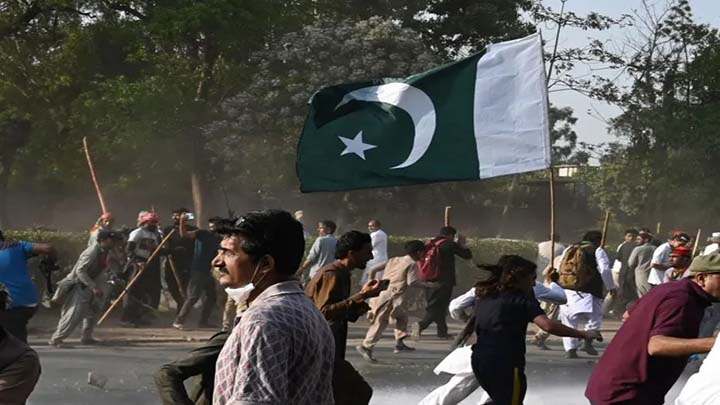
It, however, continues to overlook the existential threat- domestic disorder caused by its failures of the establishment to address critical issues facing the nation. Today, Pakistan is moving towards authoritarianism and subjugating all the institutions. Its military rule all the way and all the pretensions of its democratic set up have come apart.
The troubling situation in Pakistan is eating way its vitals and the only institution benefiting from this chaos is the army. Now with the appointment of Field Marshal Asim Munir as Chief of Defence Staff, Pakistan has moved to full-fledged authoritarianism. This is not the perception driven by foreign powers but by country’s own thinking class. This has been deemed as one of the three-front security challenges that Pakistan faces. It has been noted with a deep concern by prominent writer and former diplomat Maleeha Lodhi in her article, “Tyranny of Geography” in Dawn newspaper.
Although she has not been able to shed typical Pakistani line of viewing and projecting India as a hostile nation, yet she has put across some of the critical issues that have placed Pakistan in a precarious state of affairs.
She noted with a deep concern: “While Pakistan may be unable to do much in the near term to defuse either of the two external affronts (ideally the Afghan front should be over time) the home front is what it can and should control. Two provinces are afflicted by insurgency while terrorists are also striking across the country. Despite notable counterterrorism gains, the internal security situation remains troubling with rising fatalities from terrorism like to make 2025 the deadliest year in a decade.”
In her subsequent reflections on the internal situation in Pakistan, she voiced her concern over the absence of debate on the substantial issues in the National Assembly, the lower house of Pakistani parliament. There is no debate on the domestic and foreign policy issues as to what is guiding the renewed Pakistan-US relations.
Her comments on the absence of debate in the parliamentary institutions and public discourse combined with a phenomenon of intolerance in corridors of power were quite telling. The first thing that leads to the idea and implementation of dictatorship is curbing on expression of views.
Pakistan had been under regular spell of military dictatorship since its inception, but now the dimensions and scope are changing. This is a system wherein the army is using the political government as its tool and making it to fulfil its agenda. Former Prime Minister Imran Khan is a case in point. This is case of sheer political and military intolerance.
In any country where debate and discussions are squelched or people are too scared to air their views, that is death of the democracy. Usually, such oppressive measures are justified by citing the need for the national security from external threats. The external threats are magnified to curb the dissent in the country. Pakistan, as always, sees Indian hand in its failures ranging from its internal situation to the failures in foreign policy. As and when it suffers defeat in foreign policy and faces disturbances, it blames India. It also criticized India’s military action of Operation Sindoor as uncalled for and whipped anti-India passions in its horrific justification for the macabre terror incident in Pahalgam. Pakistan sponsored and trained terrorists had killed 26 civilians, 25 of them tourists, and one local Kashmiri, on April 22, 2025. It felt that it can get away with the gruesome act of terror, forgetting that India, under the leadership of Prime Minister Modi has zero tolerance toward terrorism, no matter from where it originates. India took the revenge of the Pahalgam attack through Operation Sindoor, targeting Pakistan’s terror infrastructure and terrorists.
Had Pakistan been honest, it would have admitted that it had violated all the norms of humanity and deserved the severest punishment. If it was not involved, it could have taken punitive action against the terrorists and their masters sitting and operating from its soil. Since, it did not, therefore, it was natural to conclude that Pakistan was directly involved in the attack that jolted the Indian nation and breached its soul. India took the action, which it deemed fit. Operation Sindoor has assumed new dimensions and brought the whole of world face to face with the threat of terrorism all across continents.
Operation Sindoor should have made Pakistan to reform itself not only with regard to its attitude and approach toward India – to vow to take action against terrorists and terror infrastructure and not allow them to use its soil for anti-India activities, but also to start addressing its internal issues. Pakistan could have taken clues from India how to make democracy functional. It did not. And the result is there for all to see, Pakistan is sinking in quagmire of its own making.
