


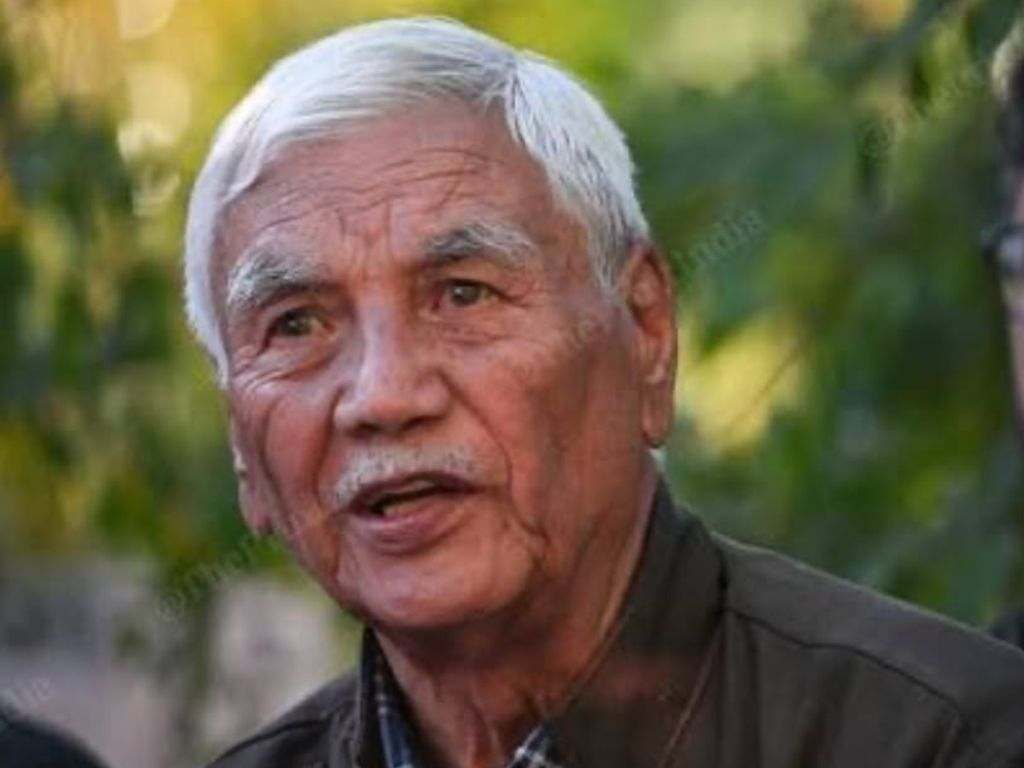
Veteran Ladakhi Leader Calls for Wholehearted Participation in December 4 Hill Council Elections, Highlights Women’s Empowerment, Eight-District Governance and the Protection of Ladakh’s Democratic Rights and National Integrity.
Pachan Charasa
LEH: Describing the forthcoming December 4 Hill Council elections as a historic opportunity for democratic empowerment, veteran Ladakhi leader Thupstan Chhewang has appealed to the people of Ladakh to participate wholeheartedly in the electoral process, emphasising that the reservation of 33 per cent of seats for women marks an important milestone in the region’s political and democratic journey.

In a significant public appeal, Chhewang urged women across Ladakh to seize this unprecedented opportunity and take their rightful place in decision-making institutions and the corridors of power. He observed that the reservation would provide women with a greater platform to participate in governance, represent their communities and contribute directly to shaping Ladakh’s future.
He described the forthcoming elections as particularly significant because they are being held following the creation of six new districts, taking Ladakh’s administrative structure to eight districts. Each district having its own elected Hill Council, he noted, would bring democratic governance closer to the people through representatives who understand the local geography, aspirations, culture and developmental requirements of their respective regions.
33% Reservation: A Historic Opportunity for Women
Highlighting women’s representation as one of the most important features of the forthcoming elections, Chhewang emphasised that the reservation of one-third of the seats creates an opportunity that women in Ladakh must fully utilise.
He called upon women to actively participate in the democratic process and emerge as decision-makers rather than remaining on the sidelines of public affairs.
The reservation, he indicated, should be viewed as an important step towards strengthening grassroots leadership, inclusive governance and greater representation of women in institutions responsible for the development of Ladakh.
He also expressed hope that the growing participation of women would contribute to a more representative and responsive system of local governance.
Eight Districts, Eight Hill Councils: Taking Democracy to Every Doorstep
Chhewang observed that Ladakh’s administrative expansion to eight districts makes it natural for every district to have its own elected Hill Council.
According to him, the creation of district-level democratic institutions would provide people with greater opportunities to participate in decisions concerning their own affairs.
He emphasised that elected representatives from within the districts would be better positioned to understand local issues and address the developmental aspirations of communities.
The forthcoming elections, therefore, represent more than an electoral exercise. They offer an opportunity to strengthen grassroots democracy and ensure that governance reaches every corner of Ladakh.
Welcoming the announcements by both the Bharatiya Janata Party and the Indian National Congress that they would contest the elections, Chhewang expressed hope that other political parties and groups would also participate, allowing democratic institutions to grow stronger through wider political participation.
Remembering Ladakh’s Seven-Decade Political Journey
Reflecting on Ladakh’s political history, Chhewang recalled the prolonged struggle spanning more than seven decades for separate administrative identity and Union Territory status.
He observed that the twin demands for separation from Jammu and Kashmir and the attainment of Union Territory status had involved an uphill struggle in which the people of Ladakh had collectively participated.
Recalling the establishment of the Ladakh Autonomous Hill Development Council in 1995, he stated that the leadership of that period had adopted a pragmatic approach by accepting the Council as an important first step rather than rejecting it because it did not fulfil every aspiration immediately.
The strategy was to continue pressing for Union Territory status while simultaneously strengthening the Hill Council as an institution.
He noted that the Council, which initially had limited powers, gradually developed into an important governing institution responsible for local administration and safeguarding Ladakh’s culture and environment.
Chhewang’s observations underline the importance of institution-building, political patience and sustained public engagement in Ladakh’s journey towards greater democratic empowerment.
National Unity, Sovereignty and Ladakh’s Strategic Responsibility
Another important dimension of Chhewang’s statement was his emphasis on national unity, India’s territorial integrity and Ladakh’s strategic importance.
He stated that the people of Ladakh had consistently demonstrated their ability to handle administrative responsibilities while maintaining their commitment to the unity of the nation.
He recalled how Ladakhis stood firmly with the country and the Indian Army in defending India’s sovereignty and territorial integrity against hostile forces along the borders.
According to him, the people of Ladakh had resisted attempts to introduce extraneous considerations into the region’s collective aspirations and had demonstrated their commitment to both regional unity and national interests.
He observed that this commitment had earned Ladakh the goodwill and respect of the country, with its people recognised as sentinels of a strategically sensitive and demanding mountain region.
He further stressed that the hard-won gains achieved through decades of struggle must not be allowed to slip away.
‘I Will Stand Like a Rock’: Chhewang’s Strong Message on China
One of the strongest and most unequivocal portions of Chhewang’s press statement concerned China’s influence and the importance of safeguarding India’s national interests.
Issuing a clear warning against expressions of sympathy towards China, whether openly or indirectly, he declared:
“Anyone who speaks of China with sympathy, openly or by implication, should know that people like me will stand like a rock against such designs.”
The statement reflects his uncompromising position on India’s sovereignty and territorial integrity, particularly given Ladakh’s sensitive geographical and strategic location.
He emphasised that democratic rights are deeply important to the people of Ladakh. Equally, he asserted that India’s pride and honour and his reverence for His Holiness the Dalai Lama remain beyond compromise.
His message was clear that the pursuit of Ladakh’s democratic aspirations must go hand in hand with national unity, territorial integrity and respect for the country’s constitutional and democratic framework.
Youth Aspirations and the Future of Ladakh
Looking towards the future, Chhewang highlighted the growing aspirations of thousands of young people across Ladakh who are eager to contribute to public life, administration, development and decision-making.
He observed that the eight-district administrative structure offers an opportunity to bring governance closer to the people and create greater avenues for local leadership.
He stressed that participation in the forthcoming elections must be comprehensive and peaceful, enabling people from all sections of society to exercise their democratic rights.
For the younger generation, the expansion of democratic institutions represents an opportunity to make their mark in public affairs and take greater responsibility for the future of their respective districts.
Describing the moment as path-breaking, he maintained that no one should stand in the way of the people’s democratic aspirations.
A Defining Moment for Ladakh’s Democracy
Chhewang’s press statement brings together the central themes of Ladakh’s political journey: women’s empowerment, grassroots democracy, institutional strengthening, national unity and the aspirations of a new generation.
The 33 per cent reservation for women provides an important opportunity to expand women’s participation in elected leadership, while the eight-district administrative framework opens a new chapter in local representation.
His appeal is also a reminder of the long journey through which Ladakh has progressed—from the struggle for a separate identity and the establishment of the Hill Council in 1995 to the attainment of Union Territory status and the present phase of expanded district-level democratic governance.
As Ladakh prepares for the December 4 elections, Chhewang has called upon citizens, particularly women and young people, to recognise the significance of this historic opportunity and participate wholeheartedly and peacefully.
His message carries two equally important dimensions: Ladakh must continue strengthening its democratic institutions and empowering its people, while remaining steadfast in its commitment to India’s unity, sovereignty and territorial integrity.
Editorial positioning: The article gives prominence to women’s 33% reservation and eight-district representation, while retaining Chhewang’s historical account, his message on China, his reference to His Holiness the Dalai Lama, and his appeal for peaceful democratic participation.
