


Pachen Charasa
In an era where digital storytelling often shapes public perception more powerfully than facts on the ground, it is worth asking a simple but uncomfortable question: Can someone become an environmentalist merely by repeatedly calling themselves one on YouTube?

Environmentalism is not built in front of a camera. It is built through years of fieldwork, scientific innovation, community engagement, ecological restoration, and measurable impact. The title cannot be self-awarded through viral videos, carefully crafted branding, or relentless self-promotion.
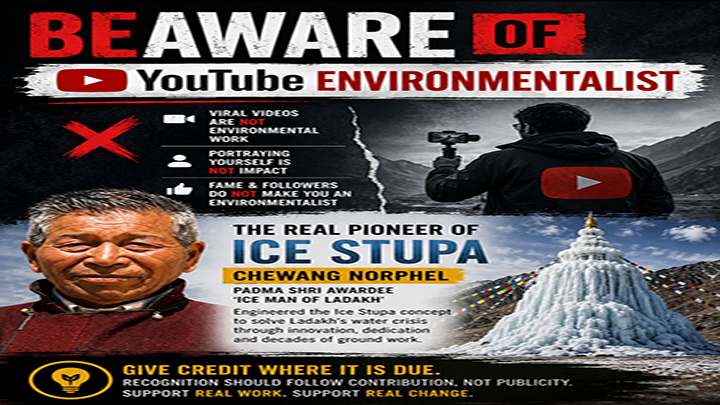
Nowhere is this disconnect more visible than in the narrative surrounding Ladakh’s celebrated Ice Stupa.
Long before YouTube personalities became household names, Padma Shri awardee Chewang Norphel had already dedicated decades of his life to addressing Ladakh’s water crisis. Widely respected as the “Ice Man of Ladakh,” Norphel pioneered artificial glacier technology that laid the foundation for innovative approaches to water conservation in the cold desert region. His work emerged from years of engineering, experimentation, and service to remote communities facing acute water shortages.
Yet today, a simple Google search often leaves the impression that the Ice Stupa concept belongs almost entirely to a social media personality. The digital narrative has become so one-sided that many across India are unaware of the contributions of the pioneers who devoted their lives to solving Ladakh’s environmental challenges long before YouTube algorithms existed.
This raises an important question: Has online visibility replaced historical truth?
Equally troubling is the repeated portrayal of this individual as the real-life inspiration behind the protagonist of the blockbuster film 3 Idiots. Over the years, this narrative has been repeated so frequently that many now accept it as unquestionable fact. However, the definitive answer lies not in media interviews or public claims but with the film’s writer and director, who alone can authoritatively clarify whether the character was inspired by any one individual, by multiple personalities, or was simply a work of fiction.
Cinema is storytelling. Social media is branding. Neither should automatically become historical evidence.
More importantly, environmental leadership cannot be measured by the number of interviews, documentaries, followers, or motivational speeches. It must be measured by sustained work on the ground. Where are the large-scale ecological restoration projects? Where are the long-term environmental programmes that have transformed Ladakh’s fragile ecosystem? Where is the independently verifiable record of conservation work that justifies the repeated projection of one individual as the face of Ladakh’s environmental movement?
These are legitimate questions—not personal attacks.
Ladakh has produced countless engineers, scientists, farmers, volunteers, monks, researchers, and local innovators who have quietly worked to protect water sources, preserve biodiversity, improve traditional agriculture, and strengthen environmental resilience without seeking national headlines. Their contributions deserve recognition just as much—if not more—than those who have mastered the art of public relations.
The danger of personality-driven environmentalism is that it sidelines genuine grassroots contributors while creating the illusion that one highly visible individual alone represents an entire movement. This does a disservice not only to Ladakh’s history but also to future generations seeking an accurate account of how environmental innovation actually evolved in the region.
Recognition should follow contribution—not publicity.
History should honour those who built solutions, not merely those who became the most visible narrators of them.
The real environmental heroes of Ladakh deserve more than footnotes in the age of influencers. They deserve their rightful place in the nation’s collective memory.
