


“Some soldiers become heroes through rank. Others become legends before they are even old enough”
At just 17 years of age, when most young men are still discovering their future, Colonel Chewang Rinchen was already defending the frontiers of India against invading forces. Within months, his extraordinary courage, leadership, and battlefield brilliance would earn him the Maha Vir Chakra, India’s second-highest wartime gallantry award, making him the youngest recipient of the Maha Vir Chakra in Indian history—a distinction he continues to hold to this day.
His story is not merely one of military heroism. It is the story of how a teenage boy from one of the remotest villages of Ladakh altered the destiny of an entire region and became one of independent India’s greatest soldier-legends.

Born on 11 November 1931 in the picturesque village of Sumur in the Nubra Valley, Chewang Rinchen was the eldest son of Kunzang Dorje and Jamyang Dolma. Nestled at the confluence of the Shyok and Nubra rivers, Sumur was a world far removed from the politics and conflicts shaping the newly independent Indian nation.
His life could easily have remained confined to the quiet mountains of Nubra had fate not intervened. During a visit to the region, a senior Ladakhi minister (Kalon) noticed the intelligence and determination in the young boy. With the consent of his parents, Rinchen was taken to Leh for formal education an opportunity that would eventually shape the future of Ladakh itself.
His younger brother, P. Namgyal, would later become one of Ladakh’s most respected political leaders, serving as Union Minister, Member of Parliament and Member of the Legislative Council. But history would remember Chewang Rinchen for a very different reason.
Barely months after India’s independence, Pakistan launched an invasion of the princely state of Jammu & Kashmir using tribal raiders supported by regular soldiers.
The strategic importance of Jammu & Kashmir was immense. It bordered Tibet, Xinjiang, Afghanistan and Pakistan, making it one of the most sensitive frontiers in Asia. Pakistan believed that by capturing Ladakh, particularly Leh, it could permanently alter the geography of the region.
As Pakistani-backed tribal forces advanced through Gilgit, Baltistan and Kargil, Leh itself came under grave threat.
The Indian Army had only a handful of troops available to defend this vast mountainous region. Reinforcements were desperately needed.
On 13 March 1948, after one of the most daring winter marches in military history, Major Prithi Chand and soldiers of 2 Dogra reached Leh by crossing the snowbound Zoji La Pass.
When local volunteers were called upon to defend Ladakh, one teenager stepped forward before anyone else.Seventeen-year-old Chewang Rinchen became the first volunteer.
Recognising his courage and natural leadership, Major Prithi Chand personally trained him in basic military skills.
Soon afterwards, Rinchen recruited twenty-eight young men from the Nubra Valley. After only thirteen days of military training, the legendary Nubra Guards was born. These volunteers would soon become the shield protecting Ladakh.
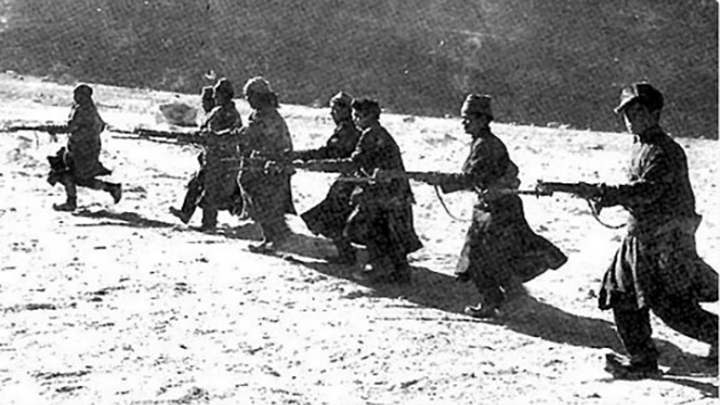
As a teenager he led the battle.On 1 June 1948, Rinchen led his volunteers on a nine-day march across the forbidding Karakoram mountains.
Their boots had worn out.Many tied strips of cloth around their feet and continued marching. Food was scarce. Temperatures were below freezing.
Yet none turned back.
On 10 June, the young commander launched an assault on the enemy position at Chumik La, killing around twenty enemy soldiers before capturing successive positions at Dzongpolas.This was only the beginning.Throughout 1948, Chewang Rinchen repeatedly led daring operations in some of the world’s harshest terrain.
At Skuru nallah, he held back a vastly superior enemy force for 23 days with only 18 largely untrained local volunteers, denying Pakistan access to the Nubra Valley.
Later, he undertook a four-day march across mountains exceeding 17,000 feet to capture the heavily defended Lama House position at nearly 4,500 metres altitude. Exploiting poor weather and complete surprise, his force eliminated enemy defenders and seized valuable weapons.
In December 1948, despite frostbite, blizzards and exhaustion, Rinchen continued offensive operations, clearing enemy positions including Black Rock and the final Pakistani-held strongholds in the Leh sector.
Under impossible conditions, he repeatedly demonstrated extraordinary courage, tactical brilliance and leadership far beyond his years.
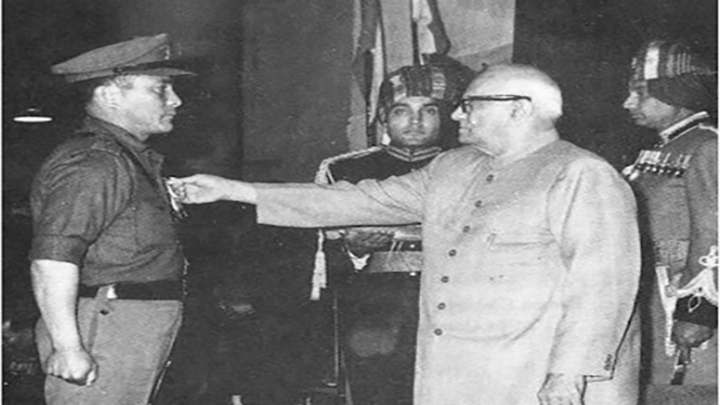
His exceptional gallantry during the 1947–48 Jammu & Kashmir operations earned him the Maha Vir Chakra
When the decoration was presented in 1952, Chewang Rinchen became the youngest recipient of the Maha Vir Chakra in Indian history—a record that still stands.
He was only a teenager when he displayed leadership that many seasoned officers spend an entire career trying to achieve.
The Maha Vir Chakra was not the end of his military journey—it was only the beginning.
Initially enrolled as a Jemadar because he was not matriculated, he steadily rose through the ranks by sheer merit and battlefield excellence.
In 1960, he became the first commissioned officer from Ladakh.
Serving with the Jammu & Kashmir Militia, which later evolved into the legendary Ladakh Scouts, Rinchen helped shape one of India’s most formidable mountain fighting forces.
Known affectionately as the “Nonnos” by the people of Nubra, these soldiers became specialists in high-altitude warfare, defending India’s northern frontiers against both Pakistan and China.
Chewang Rinchen’s courage was not confined to 1948.
During the 1962 Sino-Indian War, he undertook hazardous patrols across uncharted Himalayan terrain, establishing forward posts close to Chinese positions under extreme conditions. His bravery earned him the Sena Medal.
In the 1965 Indo-Pak War, now a Captain, he conducted long-range patrols deep into Baltistan and earned the title “Lion of Nubra.”
His finest hour, however, came during the 1971 Indo-Pak War, when he led the audacious operations that liberated Turtuk, Tyakshi, Chalunka and neighbouring villages, extending India’s control west of the Shyok River.
For these extraordinary operations, he was awarded the Maha Vir Chakra**, becoming one of the very few Indian soldiers to receive the nation’s second-highest wartime gallantry award *twice*.
Colonel Chewang Rinchen’s military career spanned decades, but his greatest legacy lies in the mountains he helped secure.
The Nubra Valley remained Indian because a seventeen-year-old refused to surrender.
The strategic regions of Turtuk and the Shyok Valley remained secure because he led from the front.
Generations of Ladakh Scouts inherited a tradition of courage because he showed what fearless leadership looked like.
Being the youngest Maha Vir Chakra awardee is a remarkable distinction.
But reducing Colonel Chewang Rinchen to a record in military history would do him an injustice.
He was the teenage volunteer who became a commander.
The village boy who became the first commissioned officer from Ladakh.
The mountain warrior who fought in three wars.
The soldier who won the Maha Vir Chakra twice.
Above all, he embodied the timeless military virtues of courage, endurance and selfless service.
Even today, nearly eight decades after his first battle, Colonel Chewang Rinchen remains the youngest recipient of the Maha Vir Chakra in India’s history—a record earned not by age, but by extraordinary courage displayed when his nation needed him most.
