



JK News Today
Leh/Kargil, July 6, 2026: A political debate has intensified in Ladakh after two nominated councillors of the Ladakh Autonomous Hill Development Council (LAHDC), Kargil, publicly questioned the rejection of the Ministry of Home Affairs’ proposal to establish Autonomous District Councils (ADCs) for all seven districts of the Union Territory.

Nominated Councillor Namgyal Phuntsok welcomed the Government of India’s efforts to accommodate major demands concerning Ladakh’s future political framework during the recent deliberations of the High-Powered Committee with representatives of Ladakh.
However, Phuntsok strongly criticised the decision of the Apex Body Leh and the Kargil Democratic Alliance (KDA) to reject the Ministry of Home Affairs’ proposal for establishing an Autonomous District Council in each of Ladakh’s seven districts during the High-Powered Committee meeting held in Leh on July 2.
He argued that every district of Ladakh has its own distinct geography, climate, culture, traditions and dialect, and said district-level autonomous councils would provide an effective mechanism to preserve these unique identities while ensuring that local aspirations and priorities are adequately addressed.
Phuntsok further noted that most districts are located far from the Union Territory headquarters and largely comprise rural areas. According to him, greater autonomy at the district level would politically empower local communities and enable them to plan and implement development programmes according to their specific needs and circumstances, thereby strengthening grassroots democracy and local self-governance.
Referring to examples from across the country where people had made significant sacrifices to secure autonomous governance arrangements, he said it was surprising that a proposal already offered by the Government of India had been rejected by the Apex Body and KDA.
He also said the people of Ladakh were left wondering why the two organisations had rejected a proposal that could have strengthened grassroots democracy and local self-governance, adding that the reasons behind the decision should be clearly explained to the public.
Appealing for a reconsideration, Phuntsok expressed hope that the leadership of the Apex Body and KDA would revisit their decision in the larger interest of the people of Ladakh. He also urged leaders and residents of the five newly created districts to come together and submit a joint memorandum to Union Home Minister Amit Shah seeking Autonomous District Councils for all seven districts of Ladakh.
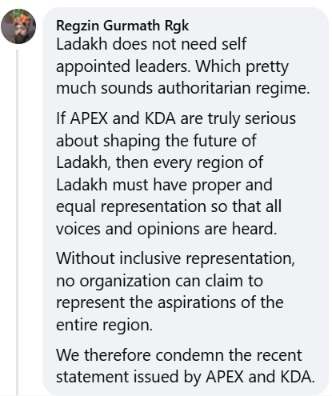
The issue gained further attention after Rigzin Gurmath, Nominated Councillor, LAHDC Kargil, also questioned the representative mandate of the Apex Body and KDA.
In his statement, Gurmath remarked that “Ladakh does not need self-appointed leaders,” asserting that if the Apex Body and KDA were genuinely serious about shaping Ladakh’s future, every region of the Union Territory must have proper and equal representation so that all voices and opinions are heard.
He further maintained that without inclusive representation, no organisation could claim to represent the aspirations of the entire region, and consequently criticised the recent stand taken by the Apex Body and KDA.
The statements by the two nominated councillors have brought renewed attention to the issue of representation in Ladakh’s ongoing political dialogue with the Centre. The debate has now expanded beyond the proposal for Autonomous District Councils to include broader questions about transparency, inclusiveness and whether all districts have been adequately represented in decisions concerning Ladakh’s future.
As discussions over Ladakh’s constitutional and administrative framework continue, the differing views within the Union Territory’s political leadership underscore the growing demand for a more inclusive and representative approach to negotiations that will shape the region’s future.
