


JK News Today
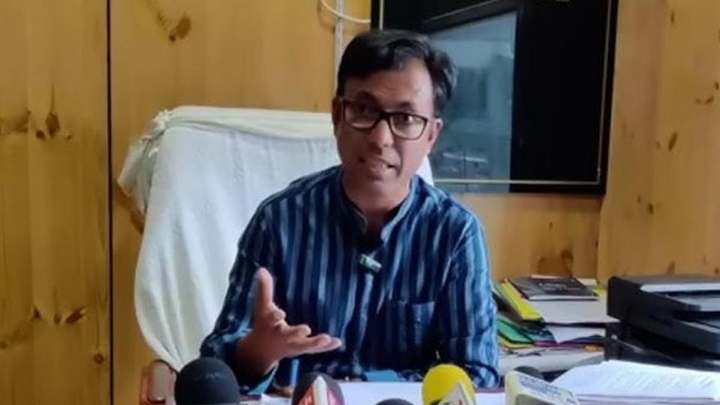
The recent public statement by Punchok Tashi, Executive Councillor of LAHDC Kargil, has brought into sharp focus what appears to be growing differences within Ladakh’s political leadership over the future governance of the Union Territory.

In his public remarks, Punchok Tashi questioned the idea of a single District Council framework and argued that every district should have its own autonomous District Council. He further emphasized that the people of Zanskar stand united in demanding a separate District Council and questioned why the aspirations of newly created districts were being overlooked.
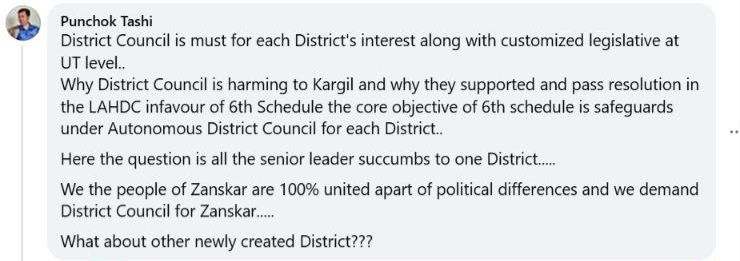
These comments have been interpreted by many observers as a departure from the position presented by the Kargil Democratic Alliance (KDA) during meetings with the Ministry of Home Affairs. If senior leaders within Kargil itself are openly advocating a different institutional framework, it raises serious questions about whether the alliance truly reflects a unified consensus.
The development also places renewed scrutiny on the leadership of Chering Dorjay Lakrook, who heads both the Leh Apex Body (LAB) and the Ladakh Buddhist Association (LBA). Holding leadership positions in two of Ladakh’s most influential institutions carries the responsibility of ensuring that diverse voices from across the region are heard before major political positions are advanced.
Critics argue that Lakrook’s leadership has become increasingly questionable because, in their view, the opinions of people from across Ladakh have not been adequately consulted before accepting positions that align with KDA’s demands. They contend that such an approach risks sidelining concerns from regions and communities with different aspirations, particularly when constitutional safeguards and governance structures are under discussion.
Among those expressing criticism is Voice of Buddhists Ladakh (VBL), which has publicly rejected what it describes as Lakrook’s willingness to concede to KDA’s demands. According to VBL, the negotiating position should reflect the aspirations of the broader Buddhist community and all districts of Ladakh rather than being shaped through compromises that, in its view, do not enjoy widespread public support.
Punchok Tashi’s intervention strengthens the argument that Ladakh is far from unanimous on the current negotiating framework. His demand for district-specific autonomy suggests that many stakeholders believe governance reforms must recognize the distinct identities and aspirations of each district instead of relying on a single model for the entire Union Territory.
The larger concern now is one of democratic legitimacy. If leaders speaking on behalf of Ladakh are not seen as consulting widely across regions and communities, public confidence in the negotiation process may weaken. Constitutional negotiations require transparency, inclusiveness, and broad public confidence—not merely agreements among a limited group of political leaders.
As discussions with the Ministry of Home Affairs continue, the people of Ladakh deserve clarity. They deserve to know whether the positions being advanced genuinely reflect the collective will of the region or whether significant differences remain unresolved.
Punchok Tashi’s statement has exposed those differences to the public. It now falls upon both the Leh Apex Body and the Kargil Democratic Alliance to explain how they intend to build a truly representative consensus that includes Leh, Kargil, Zanskar, and the newly created districts before presenting Ladakh’s future constitutional roadmap to the Government of India.
