


JK News Today
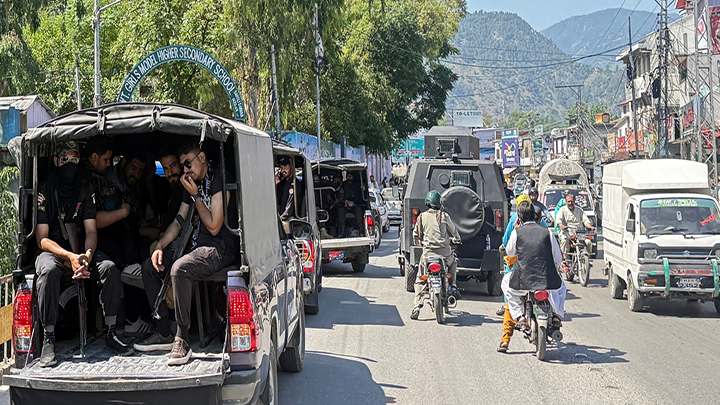
The authorities’ violent and sweeping crackdown on protests in Pakistan-administrated Jammu and Kashmir – including an internet shutdown, mass arbitrary arrests, and deadly use of force – continues an alarming deterioration of human rights in the region, Amnesty International said.

On 5 June, the region’s authorities issued a notification designating the Jammu and Kashmir Joint Awami Action Committee (JKJAAC) as a “proscribed organization” under the first schedule of the Azad Jammu and Kashmir Anti-Terrorism Act, 2014. The JKJAAC is a grassroots movement advocating for the economic and political rights of the people of Pakistan-administered Jammu and Kashmir. The group planned to go ahead with a rally today despite a ban by the authorities.
“Branding a grassroots organization as ‘terrorist’ on vague grounds, while simultaneously cutting the region off from the outside world, raises serious concerns regarding the Pakistani authorities’ conduct and their disregard for human rights. The proscription of JKJAAC under anti-terror laws is disproportionate, unlawful and a violation of the right to freedom of association,” said Isabelle Lassee, Amnesty International’s Deputy Regional Director for South Asia.
The proscription of JKJAAC under anti-terror laws is disproportionate, unlawful and a violation of the right to freedom of associationIsabelle Lassee, Amnesty International’s Deputy Regional Director for South Asia
“Sealing” the region
On 5 June, Pakistan’s government announced that elections would be held in Pakistan-administered Jammu and Kashmir on 27 July. On the same day, it suspended all internet and mobile network signals in the region until 12 June, ahead of a protest planned by the JKJAAC for 9 June after negotiations with the government over the make-up of the region’s legislature broke down.
On 5 June, the authorities also issued an advisory to “outsiders” to avoid travelling to the region from 5 June to 20 June and instructed visitors, particularly tourists, to leave immediately. It was also reported that federal paramilitary troops were deployed.
Activists working with the JKJAAC outside Jammu & Kashmir say that these actions have effectively “sealed” the region, making the flow of information from inside extremely difficult. Those reporting on the protests have also been targeted by authorities. On 6 June, journalist Sohrab Barkat, who is from the region, was arrested under sections 20 (defamation) and 26-A (fake and false information) of the Prevention of Electronic Crimes Act, 2016 for allegedly “promoting” and “endorsing” the JKJAAC through his YouTube channel. He is currently being held in custody on physical remand.
Escalating crackdown
Since 5 June, the authorities have carried out a brutal crackdown against JKJAAC leaders and members. According to media reports, police arrested more than 100 people associated with the JKJAAC on 6 and 7 June, and raided and sealed the organization’s central office in Muzaffarabad city on 7 June.
JKJAAC activist Shahzeb Habib was shot during an encounter with police on the night of 5 June. He was reportedly travelling in a car with JKJAAC member Umar Nazir Kashmiri when their vehicle was stopped. There is no indication that Shahzeb posed an imminent threat of death or serious injury to the officers. He later died from his injuries.
On 7 June, people gathered outside the Combined Military Hospital (CMH) in Rawalakot where Shahzeb’s body had been brought for a post-mortem. It has been confirmed by police that at least eight protesters and four police officers were killed during ensuing clashes between law enforcement and protesters. A further 23 police officers and 50 protesters were reported injured.
The alarming escalation of violence, including deaths of protesters, raises serious questionsIsabelle Lassee
“The alarming escalation of violence, including deaths of protesters, raises serious questions. The authorities must conduct an independent inquiry into allegations of the extrajudicial killing of Shahzeb Habib, a thorough and independent investigation into unlawful killings of protesters in Rawalakot and also investigate the alleged deaths of police officers. Those responsible must be held to account in line with international human rights standards,” said Isabelle Lassee.
“Pakistani authorities must take immediate steps to deescalate the situation and practice restraint and strict adherence to international standards on the use of force, and only use force as a last resort, and in line with the principles of necessity and proportionality. Ahead of the upcoming regional elections, it is imperative that Pakistan facilitates peaceful assemblies and does not restrict the right to freedom of association. This should start by lifting the unlawful ban on JKJAAC.”
Background
Talks between the JKJAAC and the government broke down in late May over demands to abolish 12 seats in the region’s legislative assembly reserved for refugees from Indian-administered Jammu and Kashmir who settled in Pakistan after 1947. According to JKJAAC, this is an outdated provision weaponized by political parties to influence the formation of the regional government. Following the failure to reach an agreement, JKJAAC announced it would go ahead with its plan to hold a region-wide strike on 9 June.
There have been previous crackdowns on JKJAAC protests in 2024 and 2025. In May 2024, Amnesty International noted the unlawful use of tear gas and lethal force during the Kashmir Long March by JKJAAC in which three protesters and one police officer were killed. In October 2025, at least nine people were killed, including six protesters and three police officers, and hundreds more injured during protests in the region.
