


JK News Today Commentary
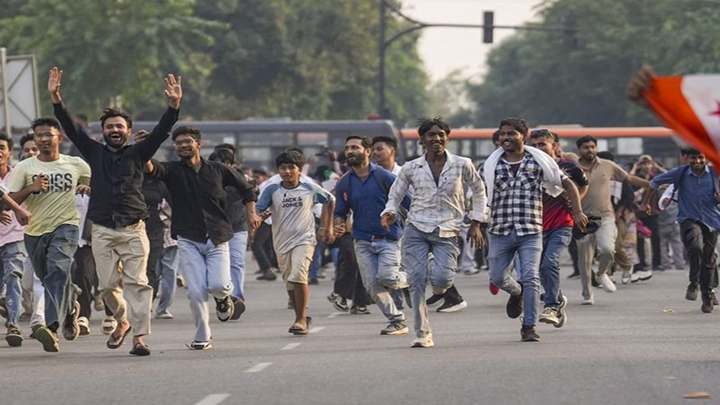
An unassailable truth of contemporary Indian politics is that street protests in Delhi and elsewhere have forged a troubling new narrative around the country’s constitutional institutions. While this narrative may not be entirely accurate, it is increasingly accepted as fact by diverse sections across the nation. The core issue, however, lies in how these institutions are being defended. The pushback against street demonstrations has been conducted in a purely partisan and political manner. This approach must change; it needs to be replaced by a public stance that handles the anxieties of the youth, and all affected stakeholders, with genuine sensitivity.
The Central Government has an immense amount at stake—far more than merely shielding the Election Commission of India , or specifically Chief Election Commissioner Gyanesh Kumar, who currently finds himself in the eye of the storm. The government must remind the public of what it took to stabilize the nation. This is not just a question of preserving a legacy, but of highlighting the formidable internal and external threats the country has successfully overcome. Over the past 12 years, the Centre has achieved countless milestones. Yet, these achievements now need to be replayed through a different lens and a fresh narrative. The outdated, aggressive semantics of the past must yield to a more empathetic vocabulary—one whose tone and tenor resonate deeply with youngsters, their parents, and society at large.
First and foremost, the string of electoral victories since 2014 did not materialize because of CEC Gyanesh Kumar. He was nowhere near the scene when the party began its triumphant march through national, state, and assembly by-elections. These are matters of historical record. It is equally a matter of record that the Opposition has successfully won its fair share of elections during this period. The argument that a pliable ECI maneuvered or rigged these elections in favor of the BJP is patently absurd. Because public memory is notoriously short, the entire record of the BJP’s wins and losses—or conversely, the electoral gains and defeats of the Opposition—must be consistently placed in the public domain. Frequent reminders will not diminish a party that has been democratically voted to power across a vast majority of states and Union Territories. Instead, as recent by-election results in West Bengal and Assam demonstrate, it will help the ruling party confidently assert its legitimate mandate.
While citizens witness these street protests, they are also increasingly aware of the real motives driving them and the sponsors funding them. That specific point must be driven home, moving beyond grand branding exercises to intimate corner meetings. Digital media undoubtedly holds immense influence, but grassroots interaction at the village and mohalla levels offers an irreplaceable human touch.
This is a long-term battle that transcends immediate political cycles. Political shortcuts cannot replace the enduring objective of safeguarding the nation from elements that seek to defame it through theatrical street agitation. The voices from the street absolutely deserve a hearing—but only when genuine public grievances are at stake. When protests are weaponized to destabilize the nation because certain political leaders find it impossible to reach the pedestal of power through democratic means, hijacking the streets becomes a deliberate tilt toward anarchy.
Consequently, both the government and the party apparatus must urgently open direct communication channels with young demographics in colleges, universities, and local communities. Many of these youths are struggling with deep self-doubt, feeling that economic opportunities have either shrunk or vanished entirely. They are indifferent to high rhetoric or the complex dynamics of a changing global order; their worldview is shaped entirely by their neighborhoods and the streets they walk.
While global challenges have multiplied and impacted India just as they have other nations, and while New Delhi has actively worked to resolve international conflicts from the Middle East to Russia-Ukraine, foreign policy achievements do not automatically alleviate domestic anxieties. A robust political outreach is required to dispel the doubts of the youth and the middle class. This is a matter of vital national security; if the government leaves a strategic communication vacuum, anarchists will eagerly fill it.
In recent days, as Delhi’s streets were broadcast as sites of intense protest, the Western international media found the exact fodder it was looking for. This global coverage provides a dangerous tailwind to elements eager to sow and water the seeds of discontent. India cannot afford this vulnerability, especially in a capital where international media and internal detractors are poised to exploit fractures.
Making matters more difficult is the bitter truth that the credibility of mainstream TV channels and newspapers—once considered the primary sources of reliable information and objective analysis—is currently at rock bottom. This trust deficit occurs at a critical juncture when the country is working to insulate itself from global economic instability and pursue high growth. The only viable way forward is to drastically improve direct communication with genuinely aggrieved citizens, ensuring they are not driven into the arms of hostile forces out of sheer helplessness.