


JK News Today
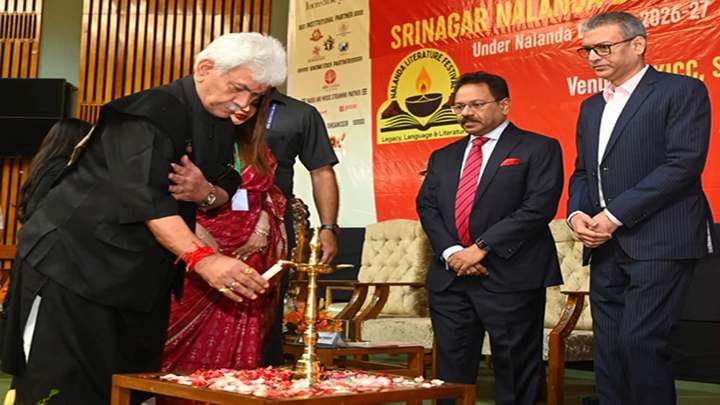
Srinagar, June 20: Lieutenant Governor Manoj Sinha on Saturday emphasized the need to revive India’s rich traditions of knowledge and spirituality while promoting a future-oriented education system that connects young people with both the country’s civilizational heritage and modern technology.

Addressing the Srinagar-Nalanda Dialogue, organised by the Ministry of Tourism, Department of Culture J&K, Indira Gandhi National Centre for the Arts (IGNCA), National School of Drama and Nava Nalanda Mahavihara University, Sinha said India’s goal should be to strengthen its civilizational traditions and prepare youth to engage confidently with the challenges of the future.
The Lieutenant Governor highlighted the role of good governance in fostering cultural dialogue, stating that both together help shape the moral, cultural and human character of society while contributing to inclusive policymaking.
Referring to the historic intellectual links between Jammu and Kashmir and Nalanda, Sinha said scholars from the two regions had contributed significantly to one of the world’s oldest living civilizations. “This heritage is our guiding light. The Srinagar-Nalanda Dialogue is our opportunity to carry that light forward with wisdom, courage and a new vision for Viksit Bharat,” he said.
Calling for greater efforts to strengthen India’s soft power, the Lieutenant Governor stressed the importance of cultural diplomacy in enhancing the country’s global influence. He noted that India had historically served as a centre of learning and intellectual exchange, attracting scholars and travellers from across Asia and beyond.
“Centuries ago, India’s knowledge unified the globe. Today, we can be the bridge the world needs. The world is watching. Let us lead with confidence and compassion,” he said.
Sinha also underscored the importance of preserving India’s cultural diversity, describing it as the nation’s greatest strength. He said young people have inherited a rich legacy of languages, philosophies, artistic traditions and ways of life that should be protected and celebrated.
Highlighting the country’s ancient centres of learning, he referred to Nalanda, Takshashila and Vikramashila as hubs of global intellectual exchange. He also described Kashmir’s historic Sharda Peeth as a renowned seat of learning that attracted scholars from distant regions.
The Lieutenant Governor said the younger generation must understand India’s knowledge traditions and their historical roots, adding that the Srinagar-Nalanda Dialogue provides an opportunity to renew these traditions as a modern intellectual project. He stressed the need to encourage the free exchange of ideas, similar to the movement of scholars and manuscripts between Nalanda and Kashmir in ancient times.
Sinha further called for strengthening the role of India’s historic towns and cities, including Srinagar, Jammu, Varanasi, Hampi, Sanchi, Madurai and Puri, through infrastructure development, heritage conservation and cultural exchange initiatives.
“We should continuously promote festivals, exhibitions and discussions that bring together artists, scholars and citizens from across the world,” he said.
Several distinguished scholars, academicians, government officials and literary personalities attended the event, including Padma Shri Prof. Shafi Shauq, Director General Tourism Suman Billa, Vice Chancellor of Nava Nalanda Mahavihara University Prof. Siddharth Singh, National School of Drama Director Chittaranjan Tripathy, and Vice Chancellors of the University of Kashmir and Central University of Kashmir, among others.
