



JK News Today
News Analysis
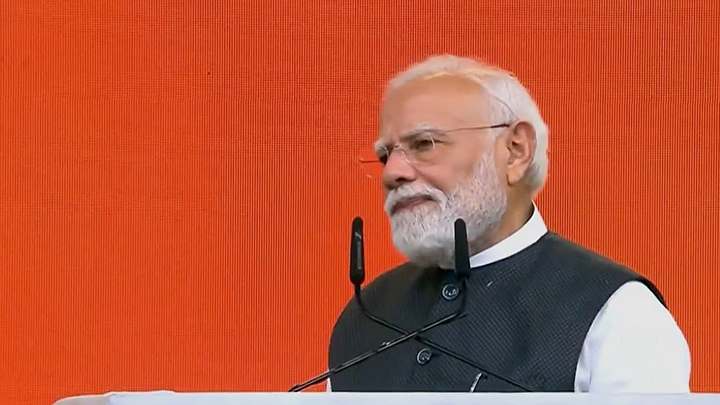
Srinagar, October 7: “We will do it.” These inspiring words by Prime Minister Narendra Modi resonated across the country on Wednesday as he marked 25 years as the head of state and national governments. During his address, he showcased a clear vision of what India will accomplish by 2047, when the nation celebrates the centenary of its independence. While this message was intended for the entire nation and its vast diversity, it resonated in Jammu and Kashmir more than anywhere else.
Jammu and Kashmir, an integral part of India since Maharaja Hari Singh acceded the vast state to the nation in October 1947, had long struggled between the idea of India and the pull of secessionism. It is a stark reality, known to the entire nation, that there were times when bullets and bombs gave violent expression to secessionist voices. Elements on the ground actively worked to make the region fertile for neighboring Pakistan to interfere in India’s internal affairs almost daily. A cloud of dispute hung in the air, leaving New Delhi worried and sleepless over how the international community would react if strong action were taken against anti-national forces.
When Modi arrived on the national scene as Prime Minister in May 2014 after securing a handsome majority in the Lok Sabha elections, these challenges were waiting for him. The threat was not just cross-border terrorism and secessionists blocking the idea of India; these forces were also actively trying to compound India’s challenges on the international front. Put precisely, J&K was an island of uncertainty. Nationalist forces frequently wondered if they would ever gain the upper hand against secessionists. There was plenty of political rhetoric, but no real hand-holding.
The situation grew far worse when Kashmiri Pandits, the original natives of Kashmir, were forced to flee the land of their ancestors and live in exile within their own country. The ballad of their return to the Vale and their homes remains incomplete.
On Wednesday morning, Jammu and Kashmir Chief Minister Omar Abdullah—who is currently waiting for PM Modi to fulfill his promise of restoring full statehood to the Union Territory—was asked how he viewed Modi’s 25 years in government. He offered a cryptic yet telling remark: “He must have done something that the people voted him to power time and again.”
This was not just an acknowledgement of what the Prime Minister has done for the country as a whole. Somewhere down the line, it was an admission that Kashmir is in a transformative mode precisely because of the decisive measures taken by the Modi government. While Abdullah may still hold reservations over the scrapping of Article 370—a move widely recognized as the momentous step taken by the Modi government to achieve the true integration of J&K with the rest of the country—the elected Chief Minister nonetheless acknowledged that something profoundly positive has occurred.
Today, even though control of law and order does not rest with him, Abdullah moves around in a physically peaceful atmosphere. This stands in stark contrast to his previous term as Chief Minister of a full-fledged state with Article 370 intact, an era when Kashmir was plagued by everything from violent street unrest to high-profile terror attacks. He and his party members were targeted several times during that period.
Admittedly, Jammu and Kashmir still faces a litany of grievances today. There is widespread frustration among the youth over rising unemployment, thousands of daily-wage workers repeatedly go on strike demanding regularization, and citizens routinely protest water shortages and power outages. However, these are the healthy signs of a vibrant democracy.
One only needs to look back a few years to a time when people prayed simply for freedom from fear and terror, unable to summon the courage to protest standard governance issues in the streets. Back then, stone-throwing protests dominated the landscape, genuine public issues were subverted by violence, and any attempt to demand basic amenities like “Sadak, Bijli, Pani” (Roads, Electricity, Water) was labeled an act of treason by radical elements.
Now, the definition of treason has shifted back to where it belongs: targeting those who challenge Indian sovereignty. By shifting this paradigm, Modi has delivered the people of Jammu and Kashmir their freedom from fear and terror, once and for all.
