



Editor JK News Today
News Analysis
What is fundamentally clear is that US Ambassador to India Sergio Gor stated a truth which Washington and its envoys had not articulated as resoundingly so far: Jammu and Kashmir is part of India. It can be viewed both as a historic shift or the realization of a reality as it existed—there is no doubt that dark clouds of our own making were allowing others to take advantage.

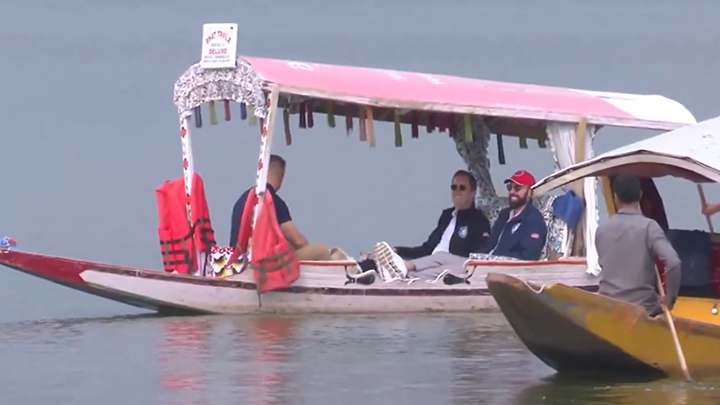
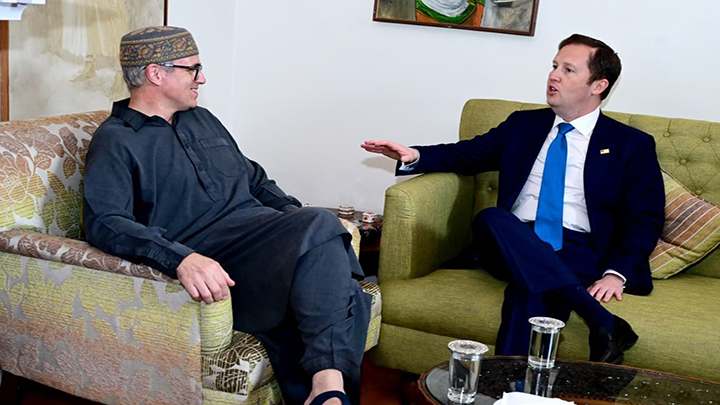
The moment Gor told the media outside the residence of Chief Minister Omar Abdullah on Gupkar Road in Srinagar, “This is an important part of India,” there was a buzz all around. This one sentence was followed by another equally important one: “It is incredibly beautiful, and I am thrilled to be here.”
These two sentences carry far greater meaning than what is currently being made out. The US envoy’s statement that Jammu and Kashmir is part of India leaves no room for any other interpretation, especially given the specific words he chose to speak before the media. In fact, he opened his statement by introducing himself and immediately adding, “This is an important part of India.” He then qualified this description by hailing the region as “incredibly beautiful”—which is exactly what Kashmir is.
The true weight of his words lies in the reality that he made this statement in Srinagar, and did so right outside the residence of the elected Chief Minister, who secured an unparalleled mandate in the 2024 Assembly elections—an exercise hailed globally as a vibrant display of democracy. For India, Gor’s statement reflects what New Delhi has maintained all along: that Jammu and Kashmir is an integral part of India.
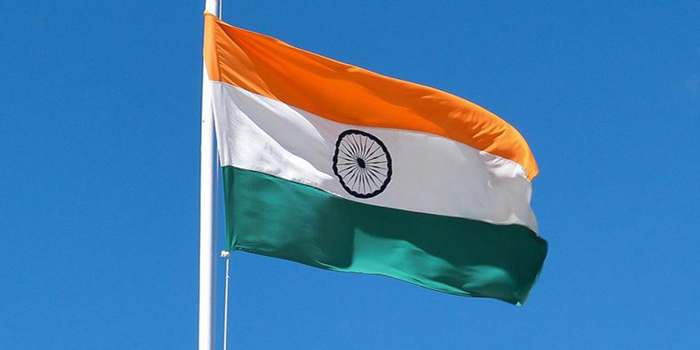
This unequivocal assertion by Sergio Gor is multi-dimensional, as it touches upon the place, the timing, and the global audience receiving his message: J&K belongs to India in absolute terms. He used the most profound words: “This is an important part of India.” Diplomats know what they are saying, why and how they are saying it, and what it means in geostrategic terms.
First, this status was established by the Instrument of Accession signed by Maharaja Hari Singh in 1947 following an invasion by Pakistani tribesmen, which was aided and abetted by the Pakistani army. Its deeper integration was later effected on August 5, 2019, when the Narendra Modi government abrogated Articles 370 and 35A, while reorganizing the state into the two Union Territories of Ladakh and J&K. The historic anomalies in Delhi-Srinagar relations, necessitated by the turbulent circumstances of 1947, were finally removed on August 5, 2019. This structural shift took place against the backdrop of a three-decade-long era of high-velocity, Pakistan-sponsored terrorism, which had deeply embedded itself on the ground and relentlessly pushed a separatist narrative. It is a recorded fact that successive political administrations from the late 1980s until the end of the 2010s failed to curb the resulting destruction and expanding graveyards.
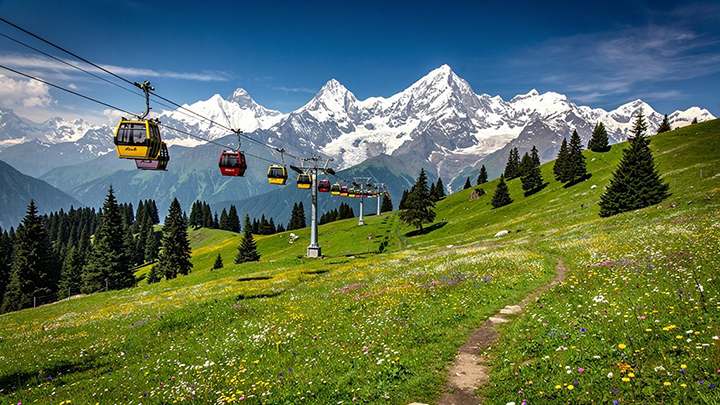
However, the intensified counter-terrorism operations undertaken following the August 5, 2019 constitutional changes successfully stabilized the security situation. Today’s Kashmir is beautiful not only because of the natural splendor bestowed upon the land, but also because it enjoys a perceptible normalcy. The credit for this transformation goes to Prime Minister Narendra Modi and Home Minister Amit Shah. Their three-pronged strategy—zero tolerance toward terrorism, robust developmental initiatives, and fostering clarity among Kashmiri youth regarding their national identity—has ushered in stability and certainty to a region once defined by volatility and high-grade violence.
It is not that Kashmiris were waiting to hear this from a US ambassador to know where they stand or which flag they salute. Nevertheless, the statement reinforces their faith in Indian nationhood, as declarations from Washington carry immense weight internationally. Kashmiri youth and elders are highly prescient in this regard. This acknowledgment will help them better navigate Kashmir’s internal dynamics within the country, while recognizing how the international community now views them: as Indian citizens on Indian territory.
There has been a flurry of instant commentary on the words spoken by US Envoy Sergio Gor in Srinagar on Wednesday. Indians are understandably heartened that the US has acknowledged this political reality in the clearest terms possible—a validation New Delhi had been awaiting for decades. It is important to note that Kashmir’s current, prominent position on the country’s political map was not always a given; the past was filled with numerous institutional caveats.
It is not that Kashmiris were waiting to hear this from a US ambassador to know where they stand or which flag they salute. Nevertheless, the statement reinforces their faith in Indian nationhood, as declarations from Washington carry immense weight internationally. Kashmiri youth and elders are highly prescient in this regard. This acknowledgment will help them better navigate Kashmir’s internal dynamics within the country, while recognizing how the international community now views them: as Indian citizens on Indian territory.
There has been a flurry of instant commentary on the words spoken by US Envoy Sergio Gor in Srinagar on Wednesday. Indians are understandably heartened that the US has acknowledged this political reality in the clearest terms possible—a validation New Delhi had been awaiting for decades. It is important to note that Kashmir’s current, prominent position on the country’s political map was not always a given; the past was filled with numerous institutional caveats.
The traditional stance of the US—aggressively pushed by the State Department and previous envoys—was that the “Kashmir issue should be settled in accordance with the wishes and aspirations of the people of Jammu and Kashmir.” Historically, Washington refused to accept regular regional elections as a definitive verdict in favor of India.
For instance, Frank G. Wisner, the US Ambassador to India from 1994 to 1997, actively pushed the line that the 1996 elections did not truly reflect the will of the people. Coincidentally, during that election, Omar Abdullah’s father, Farooq Abdullah, had won a resounding two-thirds majority.
At the time, the US justified its skepticism through two arguments: first, that voters were coerced into lining up at polling booths (which was true to some extent), and second, that the Hurriyat Conference—the primary separatist conglomerate—had boycotted the polls. The Hurriyat, then headed by Mirwaiz Umar Farooq (who also serves as Kashmir’s chief priest), boycotted the elections by claiming that participation would legitimize Indian rule in Kashmir.
Today, the geopolitical landscape has undergone a historic shift. The US has officially acknowledged the will of the people reposed in the elected government of Omar Abdullah, a factor that played a pivotal role in shifting Washington’s long-held perception.
Anyone wishing to gauge the profound significance of Sergio Gor’s assertion need only read the official reaction from Pakistan’s Ministry of Foreign Affairs (MOFA), which has been left completely shattered. The Pakistani MOFA’s reaction is an endless lament—a diplomatic admission that Islamabad has entirely lost the plot.
