



Editor JK News Today
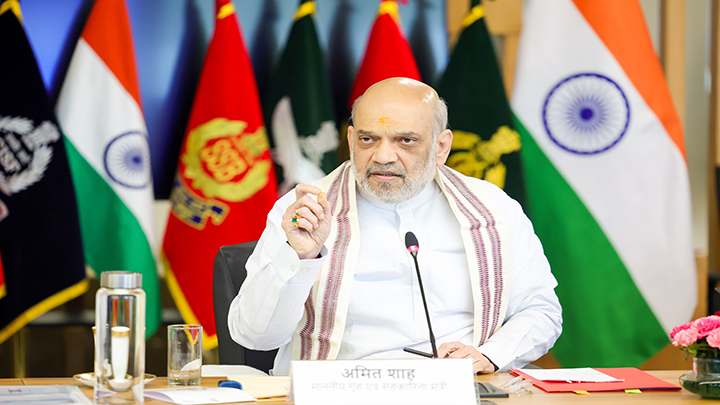
At the Land Border Districts’ Superintendents of Police Conference in New Delhi on Thursday- July 9, 2026- , Union Home Minister Amit Shah declared , The country has been freed from Naxalism and terrorism in Jammu & Kashmir and the North-East, which is an indicator of our collective success, “ and added with confidence that “In the next three years , we will inflict serious damage on the narcotics menace and achieve victory over it as well.”
This statement reflects current- day reality of the country, but is more appropriate and relevant in regard to Jammu and Kashmir . Th Home Minister is right in his assertion that all this happened under the leadership of Prime Minister Narendra Modi , crediting his clear stand against terrorism and all other forms of violence and extremism that plagued the nation before his arrival on the national scene in May 2014.
Changes in governments do make changes in attitudes and approaches in governance , especially regarding national security . Unfortunately, the nation could not display that clear-eyed way of doing things- offering a vision of a peaceful India where infiltration, terrorism and other violence are brought down to zero , but also maintain that level of success through zero tolerance toward terrorism.
This doctrine has delivered its handsome results . Compared to the situation in the past, things are looking bright , but these have not diminished the challenges . This holds true for the land border districts across the country .
It was in view of these challenges that the Home Minister also disclosed that “a strong system is being built to make the country completely infiltration-free and to ensure that infiltration does not happen at all,” as he pointed out that “ earlier, problems were permanent and solutions were temporary. In the Modi government, we are striking at the roots of the problems and making the solutions permanent.”
It is important here to note the fact that, had there been no infiltration from across the border, there would have been no terrorism in Jammu and Kashmir . The misleading propaganda to lure Kashmiri youth to rise against the country , though undoubtedly there were internal reasons too– was at the core of the proxy war that Pakistan unleashed in Jammu and Kashmir , in what it called a strategy “ bleed India by a thousand cuts.”
In today’s context, that is as of July 2026, when we are just days away from seven years of the abrogation of Article 370, Article 35 A , and the bifurcation of the erstwhile state into two Union Territories of Ladakh ,and J&K, the region is normal This normalcy underlines in no uncertain terms the fact that the entire Jammu and Kashmir has been freed from terrorism.
This is not just a statement , but a palatable and palpable reality. The people of Jammu and Kashmir can vouch for it both in letter and spirit .
This transformation has come about after a definitive change in the overall situation ,but the borders and security there remain a critical issue. The Modi Government and Ministry of Home Affairs , under the dynamic leadership of Amit Shah, have given a new definition to the security in border states and UTs. It has been taken to the roots – bringing together all the critical elements : Public , Civil Administration , Military and BSF . The police, in this new mantra of “ Quadrangular Security Grid” have a critical role to play , for they understand dynamics of the lives of people living in border villages better . The police are the basic bridge between the military -BSF and civil administration . Therefore , the Conference on Land Border Security is a big step forward in strengthening the security .
Jammu and Kashmir has eight border districts , five of which are in the Jammu region: Kathua , Samba , Jammu , Rajouri and Poonch . While Jammu shares both the international border in plains with Kathua and Samba. It also shares LoC with Rajouri and Poonch districts in south of the Pir Panjal range of Himalayas . The IB starts from Paharpur in Kathua district , which adjacent to Punjab , and travels up to the Chicken Neck area in Jammu district ; from there it winds up to Rajouri and Poonch , traversing jungles, rivulets and undulating mountains .
The Kashmir valley has three border districts – Baramulla, Bandipore and Kupwara- – all of them along LoC . This region features highly difficult terrain . These districts served as major infiltration routes in the 1990s and continue till date .Infiltration is a common threat in all districts to the north and south of the Pir Panjal Range , which the Valley from the Jammu region . The districts in the Jammu region have recently witnessed increased drone activity and the droppings of drugs , fake currency, arms and ammunition
It was against this backdrop that new initiatives were suggested to have a leak-proof security grid in every respect : wherever physical fencing is difficult , a technological fence must be deployed . Equally important is that the police be involved in countering the disinformation and misinformation both within and from across the border. That , in itself, will be a big and higher fence transcending the physical and technological ones , as that will strike at the roots of the whole problem .
A mechanism needs to be put in place to achieve better results . In fact, the Home Minister has always exhorted the concerned forces to do so. The requirement is that police officers in border states and UTs should be highly trained in these skills and possess excellent communication abilities . Furthermore , they must be tech savvy- men and women with profound ideas on border security and public safety , with a special focus on the youth.
