


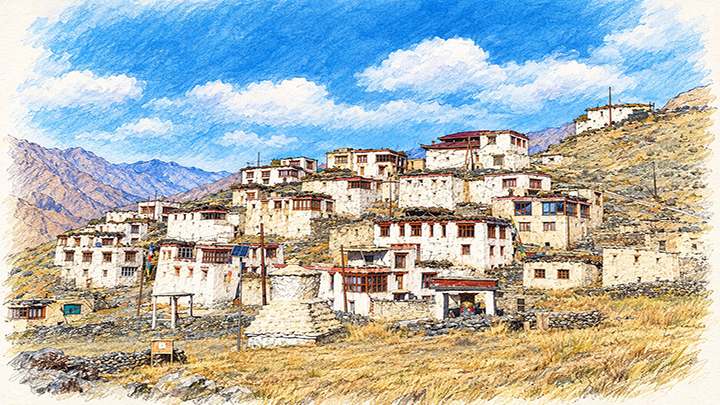

Ladakh’s first Heritage Village can become a destination for sustainable tourism, traditional village life and a new generation of travellers
There are villages in Ladakh that are beautiful because of their landscape. Then there are villages that carry something more—the memory of how people lived, worked and survived in the mountains for generations.

Kumik is one of them.
With its recognition as Ladakh’s first designated Heritage Village, Kumik has an opportunity to put its unique character on the wider tourism map. Its traditional homes, stone walls, agricultural landscape and distinctive mountain setting offer something that is becoming increasingly difficult to find elsewhere: an authentic Himalayan village that has not been shaped entirely around tourism.
But Kumik also tells a more difficult story. The village has faced the effects of changing water availability, including the loss and decline of dependable glacial water, making farming and everyday life increasingly difficult. As a result, many families have moved away.
That reality should be at the heart of any discussion about Kumik’s future.
A village should not become a museum
The purpose of declaring Kumik a heritage village should not be simply to preserve old houses and turn the settlement into an open-air museum.
Its real heritage is the life that once filled those houses.
The traditional architecture, fields, paths, water systems, stone walls and relationship with the surrounding landscape all form part of Kumik’s identity. Preserving them is important, but equally important is finding a way to make the village viable again.
Imagine visitors staying in restored traditional homes, eating local food, walking through the old settlement, learning about Ladakhi architecture and agriculture, and listening to stories of how people lived in this difficult landscape.
That would be very different from conventional sightseeing.
People would not come merely to take photographs of Kumik. They would come to understand it.
The new traveller is looking for something different
Tourism is changing. Many travellers today are no longer satisfied with a quick visit to a famous viewpoint followed by a hotel stay.
There is growing interest in slow travel, local culture, traditional food, nature, heritage and meaningful experiences.
Kumik has the potential to attract precisely this kind of visitor.
It could appeal to people interested in Himalayan culture and architecture, sustainable tourism, traditional agriculture, photography, conservation, research, wellness and simply experiencing village life away from crowded destinations.
There is also an opportunity to attract digital nomads and long-stay visitors.
A small number of traditional homes, restored with sensitivity and equipped with good internet, clean energy and basic modern facilities, could allow people to work remotely while living in an authentic Ladakhi village.
The idea should not be to turn Kumik into another resort.
In fact, the opposite should be the aim.
Kumik’s attraction would be that it remains Kumik.
But water has to come first
No tourism plan can succeed if the basic conditions for village life are not secure.
For Kumik, that means water.
The village’s traditional water sources and systems need to be properly understood and documented. At the same time, modern solutions could be explored—snow harvesting, better water storage, efficient irrigation, rainwater collection wherever feasible, grey-water recycling and other water-saving technologies.
Ladakh has a long history of managing scarce water. Traditional knowledge should not be discarded in the name of modern development. Instead, it should be combined with appropriate technology.
The first question should therefore not be: How many tourists can Kumik accommodate?
It should be: How many people can Kumik sustainably support?
That distinction could determine whether the project succeeds or fails.
Kumik can tell the story of a changing Himalaya
There is another reason why Kumik could become important beyond tourism.
Its story reflects a much larger issue facing mountain communities across the Himalayas: how to maintain traditional ways of life as climate and water conditions change.
A visit to Kumik could therefore offer more than beautiful scenery. It could help visitors understand traditional Ladakhi architecture, farming, water management and the relationship between a community and its environment.
The village itself could become an example of adaptation—showing how an old settlement can respond to new environmental realities without losing its identity.
This could give Kumik a relevance far beyond Ladakh.
International standards, but a distinctly Ladakhi character
If Kumik is to attract international visitors, its development should meet high standards of sustainability and visitor management.
That means proper waste management, clean water and sanitation, renewable energy, responsible construction, protection of traditional architecture, community participation and careful management of visitor numbers.
There should be no rush to construct large hotels or concrete structures simply because tourism is growing.
The best approach would be small-scale, locally owned and environmentally sensitive.
Traditional buildings could be restored rather than replaced. Local materials and architectural styles could guide new work. Homestays could be developed around existing homes. Local food, handicrafts and agricultural products could become part of the visitor experience.
The emphasis should be on quality rather than quantity.
Kumik does not need thousands of tourists.
It needs the right visitors—and it needs those visitors to spend more time and contribute more to the local economy.
The real measure of success will be the people
A heritage village cannot survive without its community.
If tourism brings income only to outside businesses, Kumik will gain visitors but lose the very character that makes it special.
The benefits should reach local families through homestays, guiding, transport, food, handicrafts, farming, cultural experiences and other small enterprises.
Most importantly, tourism should create a reason for younger generations to see a future in their ancestral village.
The ultimate success would not be the number of photographs posted from Kumik.
It would be seeing life return to its homes.
A different model for Ladakh
Ladakh already has destinations that attract large numbers of tourists. Kumik has the opportunity to follow a different path.
It can become a place where tourism is deliberately kept small, meaningful and connected to the local community.
Not a resort.
Not a theme park.
Not a reconstructed version of a traditional village.
But a living heritage village.
Its greatest asset is something no developer can build and no marketing campaign can manufacture: authenticity.
Kumik has the opportunity to tell an extraordinary story—a story of traditional architecture shaped by climate, agriculture shaped by water, culture shaped by the mountains and a community trying to adapt to a changing environment.
Its future should therefore not be about turning Kumik into something it is not.
It should be about giving Kumik the conditions to survive as itself.
If heritage conservation, water security, local livelihoods, renewable energy and responsible tourism can be brought together, Kumik could become much more than Ladakh’s first Heritage Village.
It could become an example for other Himalayan communities facing the same question:
How do we preserve where we came from while creating a reason to remain—and a future worth returning to?
