



JK News Today Commentary
Kashmir must have been at the top of Union Home Secretary Govind Mohan’s mind when he remarked that internal security across the country has changed irrevocably. While other regions have suffered from terrorism and turmoil, no territory has represented both internal and external threats quite like Kashmir—dating back to even before it acceded to India on October 26, 1947.
The fact is , Kashmir has been reclaimed. This achievement is a high point, especially as insurgencies and militancy elsewhere have also been neutralized. While this shift has helped reshape prevailing narratives, the effectiveness of these new narratives is still wanting in some ways. Moving forward, the focus—apart from meeting old, continuing, and emerging challenges—must shift toward building robust narratives at both the national and regional levels. This requires an integrated strategy that maintains national security while simultaneously averting threats emanating from across the borders and from within.
Importantly, this transformation in Kashmir’s security landscape helped frame the Home Secretary’s address at the Dikshant Parade of the 78th Regular Recruit (RR) batch of IPS officers at the Sardar Vallabhbhai Patel National Police Academy (SVPNPA) in Hyderabad on Saturday, October 17, 2026. During the event, he noted that militant Naxalism has conclusively come to an end and the North-East insurgency has been reduced to minuscule levels.
“Homegrown terrorism has almost ended, while foreign-inspired terrorism is no longer visible in any other part of the country,” he said, underlining the measures that have helped meet these national security challenges.
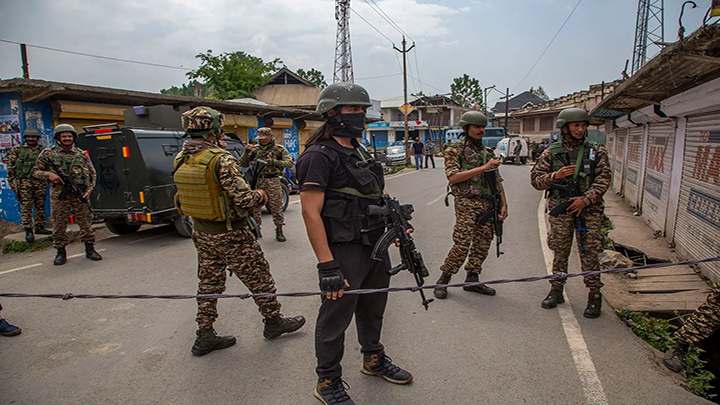
The government gained the bandwidth to mobilize strategic and security resources once guns and grenades fell silent in the Valley, replaced by a sense of normalcy. Kashmir had long been a 24/7 national obsession—an unspoken reality sitting between the lines of the Home Secretary’s speech.
It was perhaps for the first time in August 2019 that the Indian State acted as a resolute state, fully conscious of its duties and responsibilities toward Jammu and Kashmir—a region long trapped in a dilemma of “to be or not to be.” Union Home Minister Amit Shah pursued a policy of absolute clarity, declaring to the people of Jammu and Kashmir and the rest of the country that all confusing, abhorrent features of the old status quo would be decisively dismantled.
Today, Kashmir is a transformed place—and calling it that is an understatement. It has achieved what it sought for decades, extending far beyond the post-abrogation (August 5, 2019) development boom into a new geopolitical reality.
Kashmir’s importance to national security must be viewed through multiple prisms. It became a battlefield between foreign powers—Pakistan, in particular—and the Indian state, each trying to cement its vision in the Valley. Pakistan pushed its narrative through conventional wars (1947–48, 1965, 1971, and the mini-war in the Himalayas in Kargil in 1999) and by framing terrorism as a form of salvation.
Though the Indian state neutralized these military aggressions, it long hesitated to take decisive action against terrorism due to its own internal contradictions. Its Muslim-majority character made policymakers weigh the sensitivities of both the local population and the broader Muslim world, alongside anxieties over how global superpowers might react.
The Modi government cast aside these apprehensions, declaring that there were no “ifs and buts” in India’s relationship with Jammu and Kashmir. Today, a clear consensus has emerged among the public that Delhi is the only viable option, and that their destiny is intrinsically linked to India. This mindset shift is far more significant than physical infrastructure or connectivity projects, as Kashmir learns to integrate a sense of “Indianness” into its worldview. While historic, this shift should not be credited solely to the current administration; rather, it marks an epoch-making threshold crossed for all time to come.
That being said, it does not mean that all fault lines in Kashmir—and elsewhere in the country—have vanished, or that national security concerns are a thing of the past. The Home Secretary acknowledged this by urging IPS officers to prepare for emerging internal security challenges like narcotics, cybercrime, and illegal immigration. These threats will only intensify as artificial intelligence expands its footprint across every sector.
Alongside traditional counter-terrorism measures, India must chart a new course in how it crafts and deploys national narratives. Crudely constructed narratives and aggressive language often backfire. Instead, regional centers should be established to study local cultures, languages, and social nuances, using them to articulate the positive ideals of India rather than just countering negativity. A refined, factual, and apolitical approach—championed by credible scholars and social media influencers—is urgently needed.
